October is our Perry Month this year, dovetailing with CAMRA’s Perry Month, since this is also the month that the kickstarter for my book, Perry: A Drinker’s Guide, is taking place. To pre-order a copy – or pick up one of the other goodies on offer – you can find the page here. Thank you!
‘The day you open a ’61 Cheval Blanc, that’s the special occasion.’
That’s a quote from the film Sideways, I hasten to point out. A film that I would absolutely urge you to watch if you haven’t, one of my all-time favourites and certainly the film that has had the most consequential impact on my life, since it was no small part of what led me to fall in love with wine and ultimately join the industry.
I myself, being a standard-issue human in 2023, have never tasted Cheval Blanc of any vintage, let alone 1961. It is one of the best, most sought-after and therefore most expensive of all Bordeaux. Sited in Saint-Émilion, on the so-called ‘Right Bank’ of the Gironde, it is one of only four wineries in that appellation to receive ‘Premier Grand Cru Classé (A)’ status, putting it right at the top of Bordeaux’s red wine tree, along with the First Growths of the Left Bank and the very best Pomerol. None of which I have tasted either, since you didn’t ask.
In the film Sideways, the lead character, Miles, describes himself as ‘living bottle to bottle’, but has a small handful of ‘gems’ he’s saving, the star of which is this ’61 Cheval Blanc he had intended for his 10th Anniversary. I shan’t tell you what happens to this bottle as it is one of the most perfectly-composed moments of the film. But I will add that it represents a bit of a joke on the part of the filmmakers – an easter egg for wine wonks – since Cheval Blanc is made primarily from Cabernet Franc, a grape of which Miles earlier claims to ‘have come never to expect greatness’. Just another way in which the film Sideways is a million light years ahead of the book from which it is derived. (Seriously – do not read the book. It is terribly written, grotesque, contrived and reads like a wine-addled frat-boy’s absurdly lurid fantasy. Spare yourselves. But for goodness sake watch the film.)
Anyway, moving on from that 400-word aside and returning to the opening quote: it is a sentiment I absolutely adore. Having spent my professional life within the spheres of wine and whisky, I can’t tell you how many stories I have heard of people who saved umpteen bottles of tremendously fancy wines and whisky in their cellars, only for the right special occasion never to come. Drinks are supposed to be enjoyed; many of them are best after ageing, sure, but they have no function other than to be drunk. At the risk of waxing slightly biblical, lay not up for yourselves these liquid treasures for too long. Get them open. The right special occasion may never come, and if it does, who’s to say that slowly and privately savouring some long-chosen drink will be the right way to celebrate it anyway? I long considered what special bottle I might find and save for a wedding. In the end I didn’t pick anything – forgot to, mainly – and I can confidently tell you that I’m overjoyed not to have. I would not have had time or space or attention to treat it as it deserved. (And if I had, it probably wouldn’t have been much of a wedding). In general, let that drink be the special occasion. Today is often as good as any.
Cider and perry are not broadly considered in the same ‘special occasion’ terms as wine or whisky. People treat those latter drinks with almost outrageous respect, even – perhaps especially – when they’re not particularly big wine or whisky drinkers. They are categories treated with awe and respect – I would argue frequently far more than they deserve. Champagne, in particular, has the market cornered on celebrations. Choosing something from the restaurant wine list for the group is often seen as some kind of proof of high and wise sophistication, as is the role of tasting it when it is brought to the table. Bringing out single malt at the end of the evening often comes with a bizarre sense of ritual. These drinks are lavished with ceremony and reverence, sometimes because they are genuinely excellent drinks, but more generally because society – or at least society here in the UK – has tacitly agreed that blanket ceremony and reverence is what these categories are due. Champagne and single malt scotch, in particular, don’t even need to try.
There are vanishingly few of us who would reserve the same awe and wonder for a decent bottle of cider or perry, and a lot of folk would think of us as slightly odd for doing so. I know if I brought a bottle of good wine and a bottle of good perry out for most of my friends, it would be the former that they showed deference to, at least initially. This is both a good thing or a bad thing. I don’t particularly want cider or perry to be subject to some of the snobberies that occasionally blight certain quarters of wine and spirits. At the same time, there are ciders and perries that genuinely do set the crown on special occasions and, returning to this article’s opening gambit, can be the special occasion in and of themselves. I’d love for that to be recognised; for more people to discover the astounding quality of the best ciders and perries and to consider them with the same wonder that is automatically conferred on wines and aged spirits by simple dint of their existence.
On Monday night I was privileged to experience one of the most special occasions of my life. Unbelievably, on the same day as the kickstarter for Perry: A Drinker’s Guide was launched, perry lovers, friends, family, readers of these pages and people who fall into all four of those categories smashed through its target in just over nine and a half hours. It was a collective outpouring of support and generosity that absolutely overwhelmed me, and the result is that the book will be going ahead and will be published in May next year. This means that perry gets the dedicated guide that it has also deserved, but it also means that a dream I’ve held since I was about four years old is going to come true, and if that’s not a special occasion, I don’t know what is.
Before it was clear that you would hit that target within the day I had mentioned to Barry of Kertelreiter that I might celebrate the target being met (if it was) with one of the samples he kindly sent me a couple of months ago. In the event the target was met at 10:30 in the evening – a little too late to crack open a 750ml bottle, even on a Ridiculously Good Perry Monday. But something was duly set aside as a celebration for a later day nonetheless.
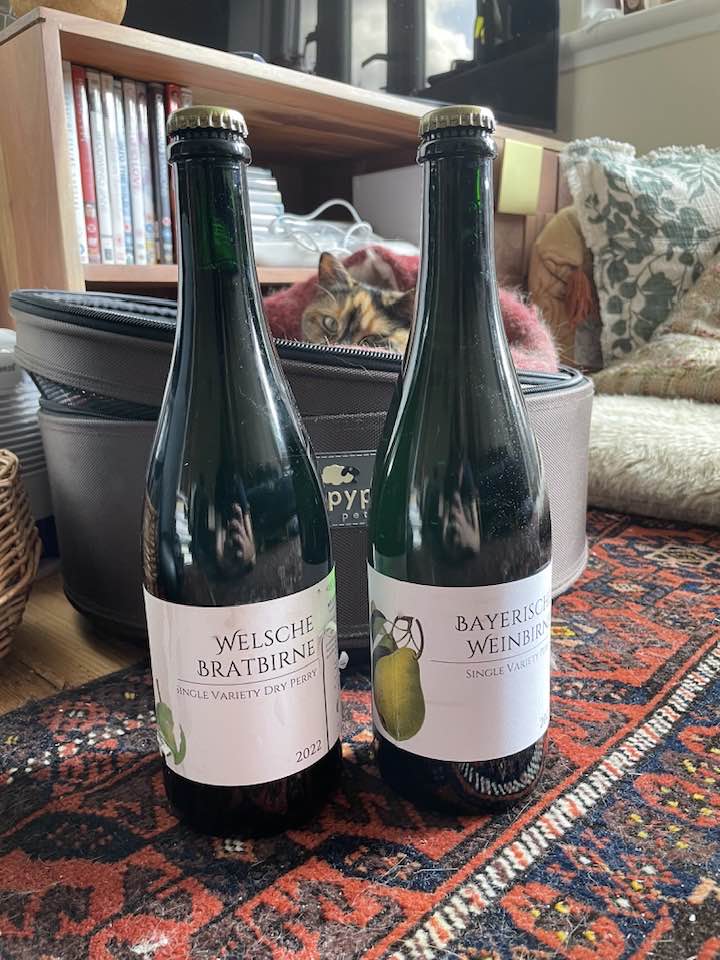
In fact, make that two somethings. Both are from 2022, both are single varieties of Central European pears, and neither single variety has been written about in these digital annals before, so I thought a side-by-side might be useful. (I love to think about celebrations in terms of how useful they’re going to be…)
The varieties in question are Bayerische Weinbirne and Welsche Bratbirne. Those suffixes are worth a quick aside. ‘Bratbirne’ seems to be a family into which pears are grouped based on their form (rather like ‘Huffcap’ in some respects, for instance). Barry tells me that ‘Bratbirne, technically, translates as “baking pear”. They are usually roundish, slightly flattened in a Bergamotte way, with large calyxes and kinda big, fluffy sepals. Usually high in sugar, with a sweet-sour flavour and usually low to mid level tannins according to Löschnig [Josef Löschnig, an Austrian Pomologist who wrote ‘Die Mostbirnen’ in 1913].’
‘Weinbirne’ seem to be a different sort of class, as they’re based less on appearance and more on utility, seeming just gaining that appellation based on their qualities. Although as an additional twist in the tale, Bratbirne has also been used as a qualitative category, with Friederick M. Duttenhofer writing in 1845’s ‘Die gegohrenen Getränke Bier, Wein, Obstmost und Meth’:
“As far as the varieties of pears are concerned which are best suited to the preparation of perry, the rule given above must also be adhered to here: those pears which are characterised by sweetness and pleasantness of taste as table fruit are on average the worst perry pears, while the varieties of pears which are so rough and astringent that they cannot possibly be enjoyed make the best perry. Among the latter, the rough pears [Rauhbirnen], the wine pears [Weinbirnen] and, above all, the roast pears [Bratbirnen] stand out, which, when treated correctly, produce a perry that not only surpasses any other fruit wine in quality, but which, when properly prepared, produces a product that is almost indistinguishable from champagne.”
So there you have it. (Folk just can’t help mentioning champagne around perry, can they?)
Anyway, representing the weinbirne corner, Bayerische is a variety I’ve tasted but not reviewed, as I’ve previously had the predecessor vintage to today’s 2022. I enjoyed that 2021, but Barry’s feeling on the 2021 vintage was that it was generally a little down on body and fruit – something that’s been born out in the 2021 perries of his that I have reviewed, compared to their predecessors. 2022 on the other hand, was seemingly as much of a blockbuster in Schefflenz as it was in Herefordshire, with ripeness levels correspondingly higher. So today’s bottle may bear scant resemblance to my previous Bayerische Weinbirne experience.
Welsche Bratbirne is, despite the name, nothing to do with Wales as far as I’m aware. First described in Germany in 1823, its perry is apocryphally excellent, but this is the first year Barry has had enough to make a single variety. Though my experience with this pear to date is nil, Barry was particularly enthused by how this perry had turned out, and I should admit that it was the bottle I’d earmarked as my special occasion burnisher before deciding to also taste the Bayerische as its sparring partner.
When I asked Barry himself about the varieties he provided this information, for which I’m tremendously grateful:
‘Bayerische Weinbirne are quite large pears that are very much the classic pear shape and would not look out of place on a supermarket shelf. A bright green base with an orange-red blush on the sun side. Very juicy, with a sweet/sour flavour and gentle, well rounded tannins and lightly spiced character. They can tend to rot on the tree and do not blett well at all, so are best pressed while still ripe and firm, but not overripe.
‘Welsche Bratbirne are small to medium-sized (depending on the age of the tree, it seems) pears that are pretty much round. The have a matt green, leathery skin, and a rather striking, almost furry star-shaped calyx that gives them away. The flesh is green-tinged white, but by the time they are falling they have often already started bletting, so the working window is very tight. The thick skins helps them keep the form, so it’s often a surprise when the browned flesh is revealed. Normally bitter-sweet in character, in the bletted state they have a honeyed, almost umami flavour and like all bletted pears, are a nightmare to press.’
Bottles are available for €14 each directly from Kertelreiter’s website, to our readers in Germany or elsewhere on continental Europe. They’re not currently available in the UK, for which I dare say we partially have Brexit to thank, but since some of Barry’s perries have previously made it across via James Clay, we can always live in hope that at some point we’ll see these too.
Kertelreiter Bayerische Weinbirne 2022 – review
How I served: Lightly chilled (suspect cellar temperature would also have done though)
Appearance: Beautiful clear blushed gold. Brisk mousse.
On the nose: When I tried the 2021 I felt it fell between Hendre and Yellow Huffcaps, and though the fruit here is certainly bigger than that vintage I stand by that statement. A big waft of ripe peach is shot through with fresh citrus peel and stony minerality. Lemons. Fresh green leaves. Some Werther’s Originals, interestingly! A lovely dovetail of plump stone fruit and woodland walk. Tremendous nose – crystal clear in its expression.
In the mouth: Dry yet fruity delivery – lovely ripeness and a distinctly vinous body kept sinewy and textural by some chewy cat’s-tongue tannins. Fruit clarity is of the usual impeccable Kertelreiter standard. Peach, honeydew melon, clementine, pear drop and lemon zest. That sense of fresh, stony pools of water somewhere in the woods persists. A silly description perhaps, but that is the sense this evokes for me. Super fruit freshness and length,
In a nutshell: Cracking, textural, whistle-clean, fresh-fruited perry. Stellar stuff. Very Kertelreiter.
Kertelreiter Welsche Bratbirne 2022 – review
How I served: As above.
Appearance: Clear mid-Gold, same mousse as above.
On the nose: Wow! Never had a perry nose like that. It’s young, but so luxuriously perfumed. Spicy; christmassy in some ways – like a christmas cake mix as yet unbaked. Tropical too; lychee, rosewater, fragrant pear. There’s almost a sense of butteriness to that baking spice quality, though it’s literally impossible that this pear has any lactic influence. Perhaps that’s just the rich opulence of the aromatics. All of which sounds very heavy – yet this is also youthful and fresh and full of green pear and apple. A nose to conjure with – and another his month that’s almost impossible to summarise.
In the mouth: Just as idiosyncratic here and totally delicious. Not too much tannin or acid – certainly less than the Bayerische – just enough for weight and freshness. Then oodles of melon and lychee and apple and pear and sweet spices and marzipan and fruit cake mix ready for the oven and lily petals and the fried egg sweets from tuck shops and a little spritz of sherbet to finish. It’s extremely complex, is what I’m saying, I suppose. Changes with every nosing. Though baking spices, tropical fruits and fresher, greener tones are I guess the headlines.
In a nutshell: Just a wonderful, full-hearted, full-fruited summer celebration of a perry. That also tastes like Christmas is coming. Well I know what I mean.
Conclusions
Well if you’ve read my pieces before, you already know what I think of Kertelreiter, and it tastes to me like 2022 was a very good vintage indeed. Two utterly different perries united in their clarity, purity of fruit expression and general excellence. If you have the opportunity to buy them, do. I think it’s bizarre they’re even still available. Germany is our third biggest readership, and those who are reading this should lose no time. It’s testimony to Barry’s skill as a perrymaker that neither is my favourite Kertelreiter of this year. But both are exceptional by any standard. Special occasion bottles indeed.
There is still time to pre-order a copy of Perry: A Drinker’s Guide. Here’s the link to follow if you’d like to!
Discover more from Cider Review
Subscribe to get the latest posts sent to your email.
 Cider Review