If you get into perry in the UK, you will come across May Hill almost immediately. It is a picturesque tufted lump in north-west Gloucestershire, crowned with pine trees that date back to the 18th century but were replenished for Queen Victoria’s golden jubilee. And the saying goes that if you’re within sight of May Hill – originally Yartleton Hill – you’re in perry pear country.
Someties the saying goes rather further, and suggests that if you’re in sight of May Hill you’re in the place where the best perry in the world grows; a suggestion at which the makers of Normandy’s Domfront and Austria’s Mostviertel would be justified in loudly clearing their throat – to say nothing of makers in Germany, Luxembourg, the USA and various parts of the rest of the UK and the world besides.
But certainly the majority of perry pear trees and perrymakers within the UK are sited at least relatively close to this landmark, sitting as it does not far from the centre point of the four primary perry counties: Herefordshire, Gloucestershire, Worcestershire and Monmouthshire.
Why should perry be so closely associated with this hill? And why do perry pears grow so prolifically around it? Well, depends who you listen to. According to local legend, at the point of the world’s creation, the gods sat on May Hill to view their handiwork. A junior godlet scurried up to the chief god, declaring that they had found a fruit that made a particularly special drink. Biting into the fruit, the chief god retched at its bitterness and spat it out, scattering the pips of perry pears around the surrounding land.
I rather like this story. Perry is often a drink of mystique and whimsy, and a tale about gods expectorating mightily from on top of a hill fits into that. But it occasionally overshadows the real reason that pears grew so prolifically here; that such a startling number of the great perry pear varieties have their origins in the villages immediately around May Hill. And that reason is dirt.
Around May Hill, and to the south, running along the Gloucestershire-Herefordshire border, is a band of Old Red Sandstone and intensely thick impervious subsoil. Apple trees do not do particularly well in it. As you spread through the Severn Vale you find an expanse of cold, heavy clay. Again, pomologists going back hundreds of years have noted that pear trees are happy in this terroir, whilst apples have complaints.
Apple trees and cider are a great deal less faff than perry pear trees and perry. Where apples did well, they were generally planted. As Tom Oliver has noted, perry pears were generally planted where there were spare bits of room. But around May Hill they thrived and were given space to thrive because apple trees didn’t.
Godlings and creation myths are a much easier sell than soil. Myths and mystique are fun and generally speaking there’s no harm to them. But there is a truth behind the existence and survival of perry pears in the area; a real reason that the place is special, that great pear varieties had a chance to originate and spread from this place. And I think it’s important to share and celebrate that as well. Three cheers for dirt!
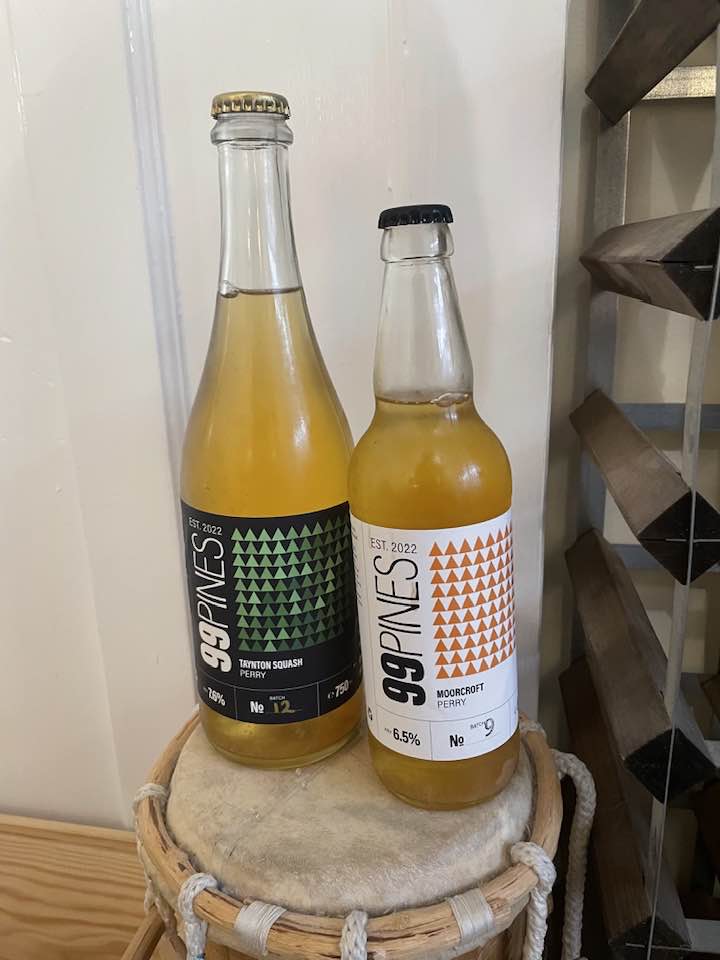
Today’s perry comes from a maker so close to May Hill that he is, in fact, on it. Phil Kester of 99 Pines is based in the village of Taynton, most famous in perry terms for the Taynton Squash pear, whose story was told by Chris here. In brief, Taynton Squash is the most historically lauded perry pear variety in British history, having been eulogised since the 17th century. Indeed in the late nineteenth, along with the Foxwhelp apple, it commanded a price far higher than that or perry made from other pears, and was so valued that a particular effort was made to save the variety when people feared it was dying out.
As you’ve perhaps surmised, today’s perry is indeed a Taynton Squash. Besides the one Chris tried we’ve only reviewed two on Cider Review – from Rob Castle and Monnow Valley. It’s relatively hard to find, so I’m very pleased to be tasting it today.
Being based on May Hill Phil is something of a perry specialist; one of those very rare makers who makes perry without also making cider. He’s only done two commercial vintages so far, but I had the pleasure of tasting a couple of his bottlings when he and I were on the Learn & Discover bar at the Great British Beer Festival together, and they are already showing tremendous promise.
Rather wonderfully, 99 Pines donates all of the profits they make to charity, last year the Teens in Crisis mental health charity in the Forest of Dean and Worcester’s St Richard Hospice. If you don’t happen to live near Gloucestershire, you can buy Phil’s perry from The Cat in the Glass. (Though this one doesn’t seem to be on the site at the moment – apologies. By way of atonement, I’ve crashed in a bonus review of a single variety Moorcroft – another fantastic variety, though very difficult to work with thanks to a fiendishly narrow ripening window (sometimes only 24 hours – which Nicky has for £4.50).
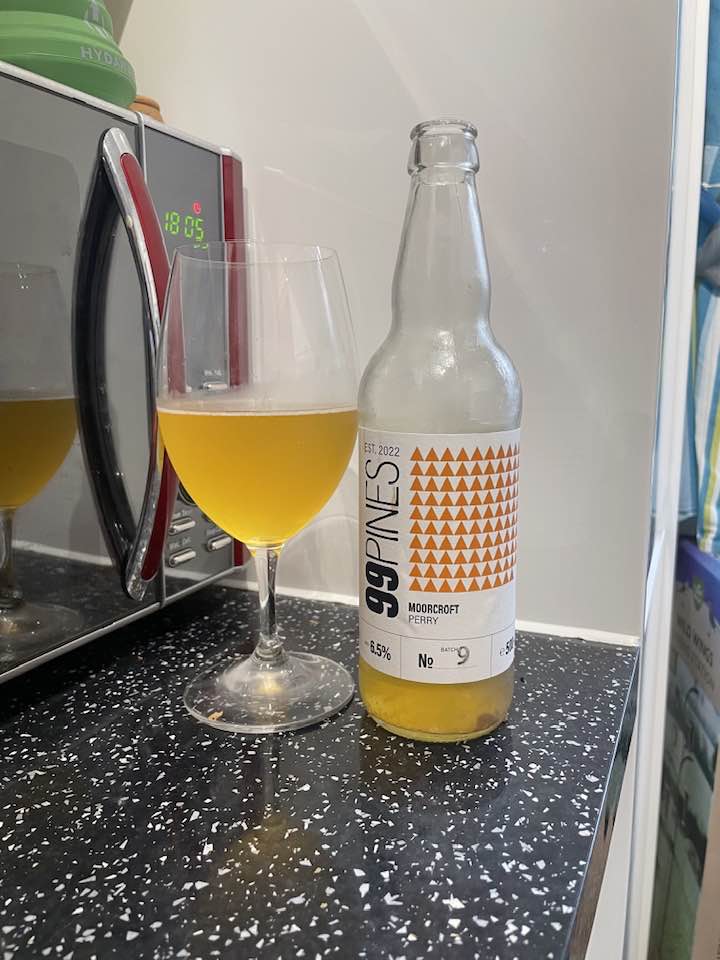
99 Pines Moorcroft – review
How I served: Medium chilled
Appearance: Hazy pineapple juice. Bright fizz.
On the nose: Smells as it looks – like big, ripe pineapple juice. A tropical cavalcade of an aroma; so full and rich that we’re into jams and jellies, though the fruit has retained freshness. Poached pear, a little baking spice. Big nose.
In the mouth: A huge tropical mouthful to match. Very full body, close to dry and just the biggest loaded fruitbasket of tropical flavour. Almost too much, but keeps just about balanced! Pineapple, mango, guava. Hard to pick out specific notes, but this perry wants a cocktail umbrella! A little acidity keeps the balance there along with well-judged fizz.
In a nutshell: A massive tropical fruit party of a Moorcroft. Drink in sunglasses.
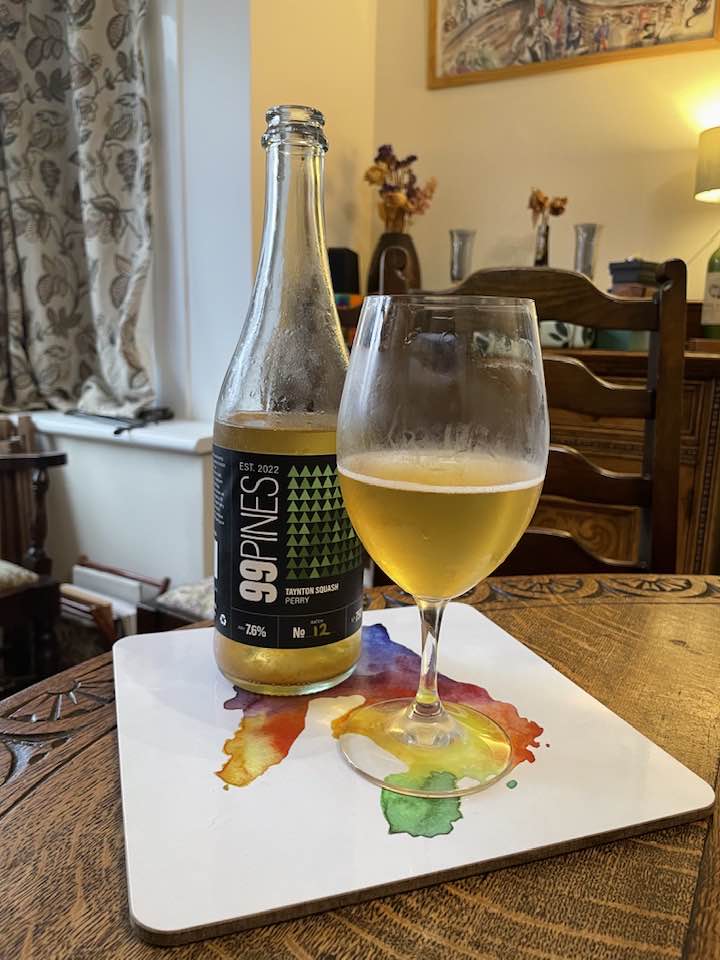
99 Pines Taynton Squash – review
How I served: Medium chilled
Appearance: Clear gold with the lightest rose brush. Light fizz.
On the nose: Fascinating aroma. Super complex; here are fresh fruits, fragrant spring to summer flowers and a slight slatey-earthy minerality. Less bombastically tropical than the Moorcroft; fruit is more apricot, fresh pear, white peach, even grape. It’s actually incredibly hard to describe – an evocative, searching, complex nose.
In the mouth: Palate follows on exactly; that combination of summer-warmed flowers, fresh apricot, pear skins and petrichor. Really well-balanced between fruit and mineral. Complex, winey, cerebral and super elegant. Full bodied yet composted, taut, fresh and refined. No jamminess at all. A little satsuma-esque citrus adds freshness.
In a nutshell: This is a beautiful, evocative and fabulously complex Taynton Squash. A very fine perry indeed.
Conclusions
Two very good perries. Cracking stuff. Interestingly, tasted blind, I might have wavered over which I thought was which. Moorcroft’s always tropical but I associate it with a seam of acidity and a leaner body than this complete fruit bomb. Whereas Taynton Squash I’ve had before has been massively hulking in its body and fruit – sometimes too much so – certainly not the elegant, complex, deliciously defined and fresh example I found here. Perhaps my favourite Taynton Squash to date, though with my limited frame of reference, perhaps this is actually how Taynton Squash ideally presents. It’s certainly a cracker – and for a fantastic cause.
Well done Phil and well done May Hill. A special place indeed.
Discover more from Cider Review
Subscribe to get the latest posts sent to your email.
 Cider Review
Pingback: The prosperous perries of 99 Pines – Hartpury’s new Perrymaker-In-Residence! | Cider Review