On a rare sunny day this summer I found myself driving down the backroads of a bit of Norfolk I’d never been to before. I live right on the edge of the fens in West Norfolk, so am used to looking out on miles upon miles of flat, mostly hedge-less arable land, a sort of prairie land reclaimed from the sea. This journey I was taking had brought me south-east, through the expanse of Thetford Forest, with its dense plantations of coniferous trees, cycle-tracks and picnic areas, and out the other side into an area of South Norfolk not too far from the English Whisky Company in East Harling. Slightly more rolling hills (and hedgerows) than home. Also, under 10 miles as the crow flies from the town of Attleborough, original site of the now defunct Gaymers Cider Company – once an East Anglian powerhouse of cidermaking, bigger than Bulmers in its day, responsible for maintaining contracts for acres of apple orchards in the region, and since the mid-90s sadly departed (along with those orchards).
It’s no factory of cidermaking I travelled to on this journey however, more cottage than industrial, certainly more selective in its fruit choice than Gaymers, and very much still a going concern in 2023. This was a trip out to visit Crones Organic Cider & Apple Juice down a long, winding lane on the outskirts of the picturesque village of Kenninghall.
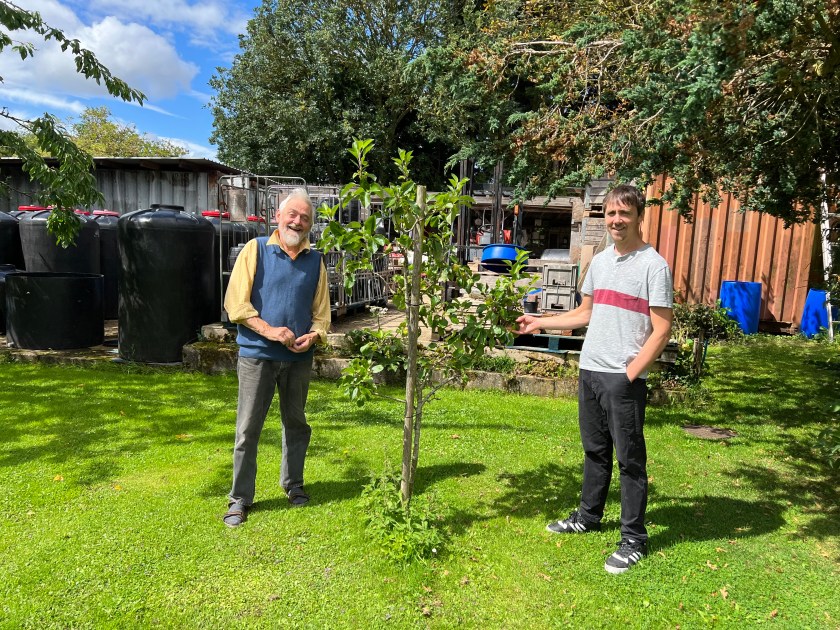
CR: I’m here in Kenninghall in South Norfolk, and although I’m a Norfolk-native, I must say this is a bit of Norfolk of not been to before. I’m visiting Crone’s Cider HQ to meet Robbie and Rudi – the Father & Son duo who are running the business. Can you tell us a bit about yourself?
Robbie: Hi there. I came over from Amsterdam in 1971, worked as an antique restorer and cabinet maker for years, and then discover the joys of cidermaking as hobby. I’ve been making cider ever since. It’s been our sole source of income here since the late 1980s. We’re 35 years into proper cidermaking now.
Rudi: I somewhat fell into the family business. Have become our chief cidermaker…chief presser, bottler, invoices, labelling, delivering. You name it. It’s basically a two man show here.
CR: So you’re both following on in this lovely tradition, which isn’t quite as common these days, of a family of cidermakers, passing on all that knowledge from generation to generation. You can spend a lifetime getting to know everything about trees and fruit and if there’s no-one to pass that knowledge onto when retirement comes calling, the business and knowledge-base can disappear. This is good to hear.
Robbie: It is, I’m delighted that Rudi is willing to carry on the business. It takes a bit of getting together. There’s tonnes and tonnes of equipment and containers that wouldn’t really be much good for anything else other than cidermaking – it would be a great shame to see it go, so I’m very pleased that Rudi is continuing the work. It’s grown from hobby quantities, to around 1500 gallons (6819 litres) one year, and probably at peak production we’ve managed to get close to 10,000 gallons (45,460 litres), but it’s been a good bit short of that in recent years. There’s too much chasing turnover when producing that volume so we’re more than happy to stick at the 4000 – 6000 gallon level (15,141 – 27,276 litres) in an average year.
CR: So comfortably over the 7000 litre a year duty threshold it sounds!
Robbie: We have had a few years under it when we started out, but virtually every year in the last 30 years we’ve been over the threshold.
CR: And that’s enough to make a living as family business?
Robbie: With the apple juice and the vinegar. At one point the apple juice took over. Because we’re exclusively organic we get into whole food shops with our apple juice and cider. We don’t just supply pubs and off licences. Quite a lot of our whole food shops have very loyal customers because of our organic status.
CR: You’re one of the few in the UK with that organic status, perhaps Dunkertons and a couple of others?
Robbie: There are others, one south of the M25 that I believe may be using biodynamic apples exclusively, but I’m not 100% sure.
CR: What’s the percentage of what you make in terms of cider and perry?
Robbie: Around 95% cider and 5% perry in the fermented product, and a decent amount of our apples go to juice. We do also convert some of the cider to vinegar – not because we’re lousy cidermakers, but because organic cider vinegar does have quite a following. Another string to our bow really. At one point our juice sales outstripped our cider sales by quite a margin. In the mid-to-late 90s we were probably one of the only organic single variety apple juice producers in the UK – Cox, Russet, Bramley, Discovery…you name it. Without any kind of advertising we managed to increase sales 50% year on year until the juice was the best part of 70% of the business.
CR: Is there as much satisfaction from making apple juices as there is cider?
Robbie: There is! To make apple juice you can use a fairly big machine and chuck in anything and everything to get a fairly bog-standard juice. But when you put them time in to make 6-10 different single variety juices, and your customers absolutely rave about them, that’s where so much of the satisfaction comes from. With cider you’re always up against Westons and Bulmers, those much bigger companies…
Rudi: There’s that issue of perception too around here with cider. Lots of customers expect ciders that are sweet and fizzy, completely clear. When they get something dry and interesting a lot of people will turn their nose up at it.
Robbie: Saying they like cider when it’s really something closer to lemonade that they like.
CR: This is why I have an affinity to your ciders! Skewing to drier presentation and quite a few barrel-aged offerings. The perfect mix! Let’s go for a wander.
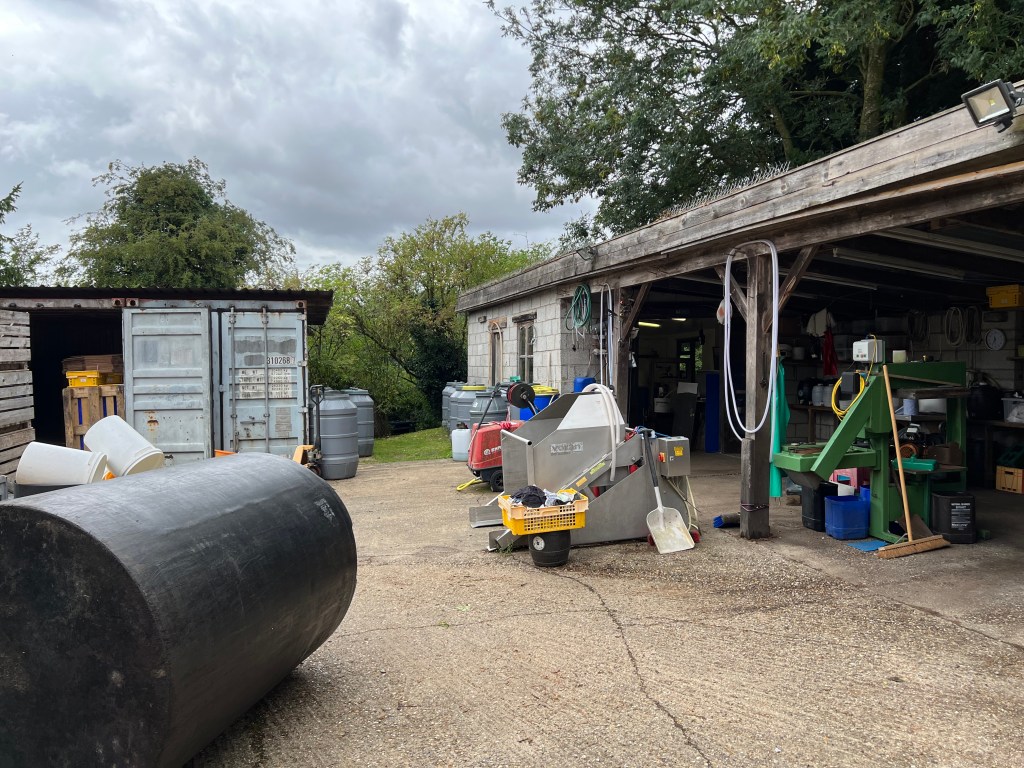
Rudi: This is the pressing area, as well as apple washing.
Robbie: In terms of our press it’s a rack and cloth operation. All very much hands-on and traditional. We have an electric motor to drive the press, if we get a power cut, we take a break.
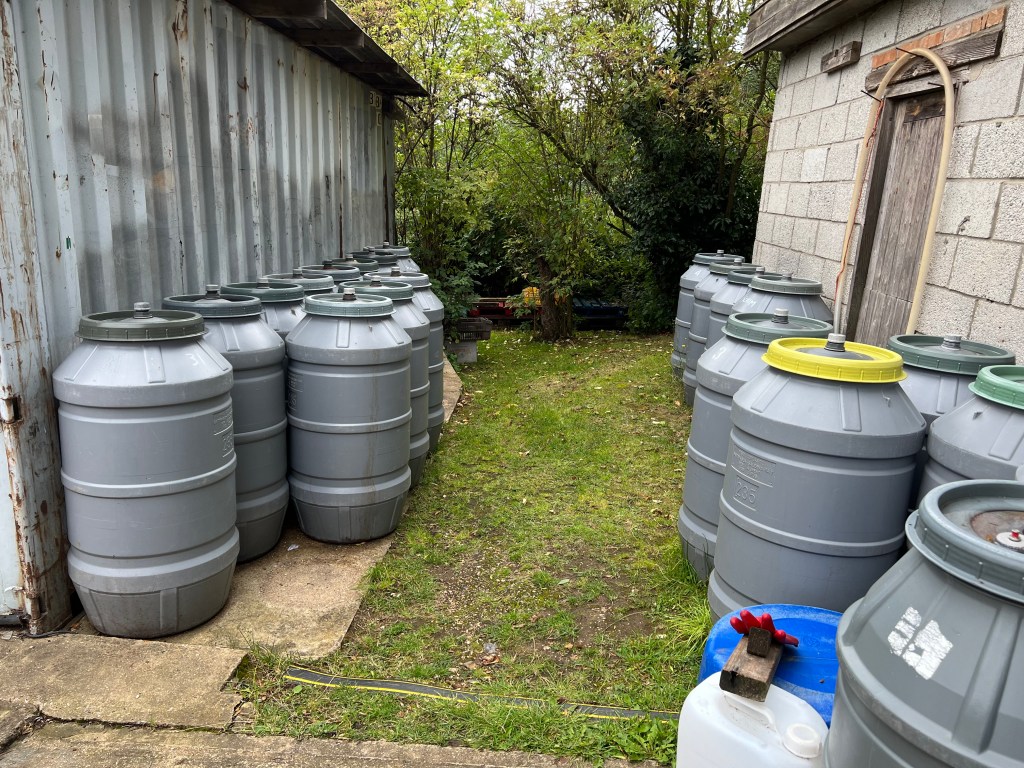
CR: I see lots of plastic barrels ahead of us.
Rudi: Yes that’s stock that’s ready for blending up and getting ready for sale.
CR: 235 litre barrels?
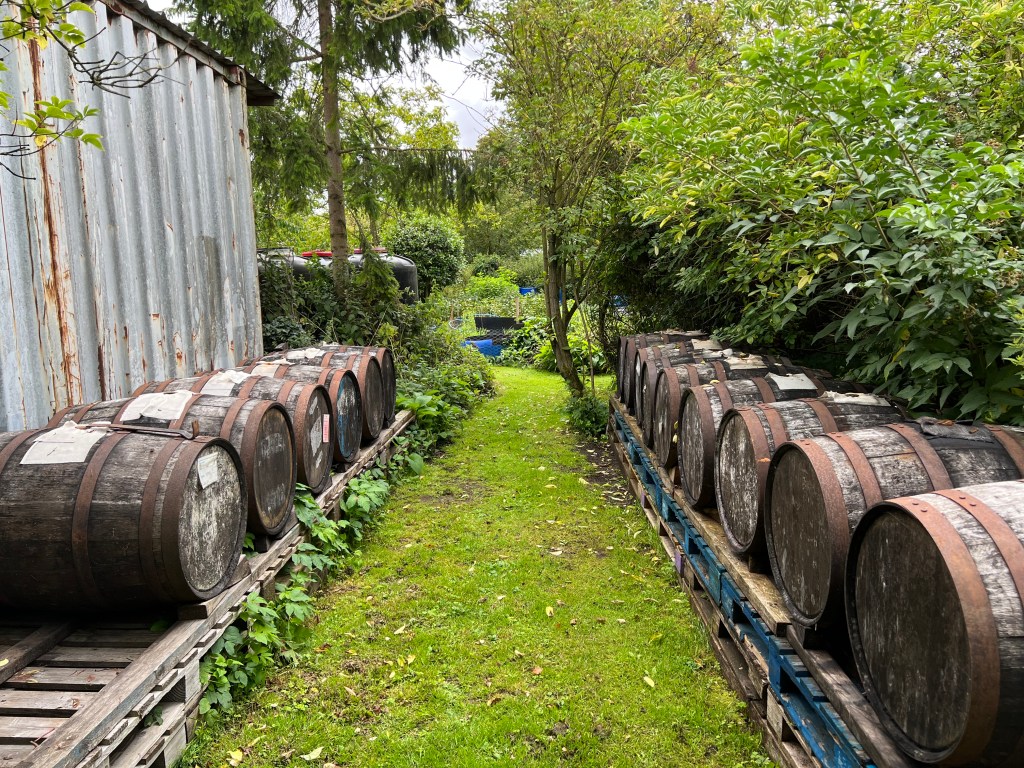
Rudi: That’s right – the cider spends a lot of time in those 1500 litre plastic barrels and some is then blended down into these smaller plastic barrels or into oak. When the specific gravity has dropped nicely and is fully fermented out then we’ll rack off into these barrels. Around the corner we have our oak aged stock – a lot of which at the moment is filled with vinegar as they’re at the end of their rummy working life. We can’t use them for rum cask cider anymore so we use them instead for oak-aged vinegar.
CR: How have you found acquiring replacement rum casks over the past few years?
Robbie: They make noises about procurement being difficult, but I think they’re talking the prices up to be honest. I don’t think there’s a shortage of barrels being made or coming into the country. Albeit in France and Canada for the rums casks.
CR: We’re stood outside at the moment, do you find these barrels mature the cider just fine outside?
Robbie: We do put damp hessian sacks over them in really sunny, hot weather. As you can see here we don’t mind a bit of surrounding greenery providing shade and keeping them cool. We’ve not had major problems with shrinkage.
CR: This reminds me of Caledonian Cider Company’s method of storing casks of cider outside up in the Black Isle. Interesting to see it can work here in East Anglia as well.
Robbie: It can be done. A summer like last year you need to make sure the barrels have damp hessian sacks over them.
Rudi: And if any do spring a leak, those get retired and turned into garden planters.
CR: If you end up with Sherry Butts you could retire them into a barrel-sized plunge pool – very refreshing in summer!
Robbie: We did used to get puncheons but they were ridiculously heavy and tricky to handle. We do need to get a few new barrels.
Rudi: We’ve got a connection for whisky barrels but I just prefer the flavour profile from rum casks.
Robbie: Our cider from rum casks tends to sell out the quickest at CAMRA festivals. The whisky cask version sold out to our wholesalers eventually, but there wasn’t the enthusiasm as with our rum cask ciders.
CR: So, perry in Norfolk…perry pears or dessert pears?
Rudi: We use mostly Conference pears.
Robbie: Our perry won first prize in the dessert pear category at GBBF a few years back. It needs constant looking after though.
Rudi: We do blend in a bit of Bramley to get the acidity levels right.
Robbie: About 15%-20% depending on the ripeness of the pear and the sharpness of the Bramley. We have also used Grenadier, an old fashioned cooking apple as well in previous years. We used to have our own orchard, around 6 acres of established organic apple trees. Again, it’s the same old problem, when you’re busy with processing fruit, bottling, making apple juice in Summer when sales are still at a decent level, to then have to do all the orchard work on top was a real challenge.
CR: So you buy in all your fruit now?
Robbie: 99% is bought fruit, and long may it continue like that for the process of our sanity.
CR: You’re then supporting a lot of the surviving orchards around here. You’re quite close to Attleborough here in Kenninghall, and after Gaymers upped and left for the South-West, that destroyed most of the orcharding culture in this part of East Anglia.
Robbie: Various growers have given up since. Some still supply conventional. But as far as organic producers are concerned in Norfolk and Suffolk, we’re the only producer in the market to pay the premium for organic fruit. These organic orchards provide far more biodiversity than a conventional one. When farmers finish a conventional spray around, there’s virtually no life left afterwards. It kills nearly all the insects – beneficial and harmful. Whereas with organic you have to rely to an extant on bluetits eating caterpillars and the like, mixed herbage to maintain soil fertility.
CR: In an Eastern Counties vs Western Counties style of cider, what are the apples you’re buying in?
Robbie: We get some cider apple fruit from a small orchard planted by an enthusiast in the late 1990s. He has now passed away and these trees would be left to go wild if it wasn’t for us visiting. The rest of the fruit are predominantly culinary apples and dessert pears.
CR: Does nothing survive of the cider apple orchard that Gaymers planted out the front of their cidery as an exhibition orchard?
Robbie: As far as I know. A friend of ours used to take some of the fruit from that old orchard, it is very close to the location of their old cider factory on the outskirts of Attleborough.
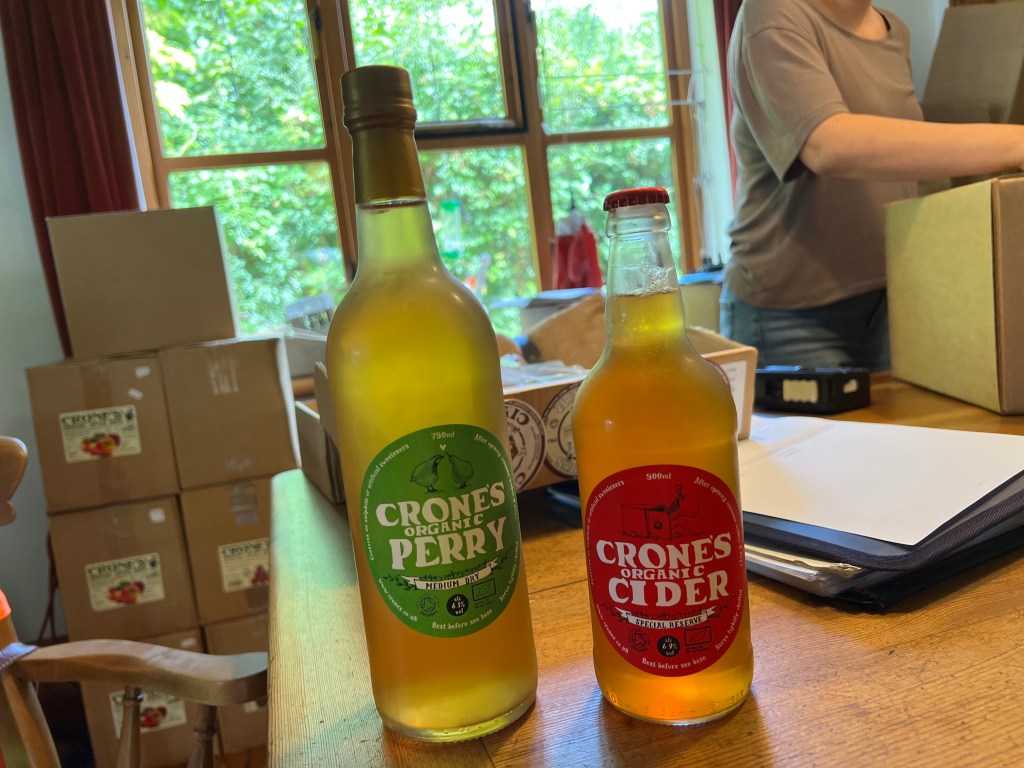
CR: I tried your bottles firstly from Bacchanalia, a lovely independent bottle shop on Mill Road in Cambridge many moons ago. Can you describe the branding of Crone’s Cider?
Rudi: The witch that used to be on our labels, relates to our surname of Crone, that was Dad who developed the initial branding. I felt it needed updating around 5 or 6 years ago so I got a friend to do some new illustrations – James Munroe – he’s an animator and illustrator working out of Liverpool. I love what he’s done with it.
CR: You’re one of the few producers I see on the market with every output in 500ml and 750ml bottles. How are you finding that in 2023?
Rudi: For many years we just worked with 750ml bottles. But over the last few years the 500ml has taken over and is now a more popular single serve it seems. They both sell though.
CR: Any BIBs?
Rudi: Yes that’s now taken over from the rigid plastic 5 gallon barrels. We’ve only got one festival customer that takes around 40 of those plastic barrels at time, every other festival has moved over to Bag-In-Box.
CR: I volunteered at the Cambridge Beer Festival this year on the Cider & Perry bar, a whole wall of BIBs and only one cider was served from that 5 gallon barrel style.
Rudi: It doesn’t surprise me, seems like no pubs want that style around here anymore. You have to be a bit more thoughtful about how you dispense it and pubs want things easy these days.
CR: What’s the fruit set looking like for you this year?
Rudi: The growers at this point of the year are a bit negative about the crop, but it remains to be seen. We’ve got our fingers crossed.
Robbie: My organic grower who supplies us with most of our varieties says the earlies are very poor, Discovery very poor, no Cox at all, pear a poor crop…so…it’s a wait and see. We had four weeks in Spring of cold, dry, East winds all around blossom set time. It was too cold for the bees.
CR: With 8.4%abv being the duty threshold at the moment for cider before it gets taxed as a wine, do you find many of yours going well above that mark?
Robbie: In a hot dry summer where varieties like Cox and Russet produce ridiculous amounts of sugar, we could probably get up to 9% abv, though I’m not aware of our ciders ever going much higher than that. We thought get most of our ciders down to 6.9% abv and below as it’s ridiculous paying that extra duty that came up it. Our customers also don’t want to get drunk that quickly, publicans want to sell people two or three pints, not one.
CR: What are your thoughts on cider culture in the UK in 2023? Where do you see yourself in the patchwork of producers around the UK?
Robbie: It’s a difficult trading climate for sure. Last year some of our glass bottle prices went up 50%. That was possibly a bit of a blip. Energy prices aren’t going to drop massively from what I can see and glass needs a huge amount of energy to produce. So bottles likely to stay expensive. Organic fruit is difficult to grow. The trees are there for 40 years plus, so you have to keep on top of maintaining the orchard. It’s a tricky act to pull off.
Rudi: I’ve observed companies like Find & Foster and Ross on Wye Cider & Perry Company being able to sell their 750ml bottles for £10 and up. I wonder whether we might be able to shift a little more in that direction. Rather than seeing ourselves as purely an affordable brand, produce more options in the higher quality end for a bit more of a premium.
CR: I’d say £10 for a bottle of Ross’s cider or perry is great value for the work they’re putting into it.
Rudi: I thought the Ross Cider was outstanding I should mention.
CR: So you’re thinking about value perception as a brand then?
Rudi: Yes, a bit more work on our branding to get there.
Robbie: Also, bottle conditioning. I’ve tried this a bit before. I’d like to try that a bit more.
Rudi: I’ve been doing a few experiments bottling at 1005 SG, not in super strong bottles, to see how they turn out.
Robbie: So we’re aiming for the higher quality end of the market, we’ll obviously carry on with the organic aspect. We’ve got all these loyal customers.
CR: By selecting organic fruit you’re already differentiating yourself from other producers.
Robbie: It certainly sets us apart, and can also limit us when the supply of organic apples can sometimes be a bit…unpredictable. Sometimes too much fruit, often too little. It’s quite a trick to pull off really. We’re always hoping that we can sell enough to keep our growers in business and they can keep us in business.
CR: And we can all help keep you in business by buying your ciders and apple juice!
Robbie: That’s you’re part of the deal yes.
CR: Where can we see Crone’s Cider around the UK next? Will you be at Nottingham or Norwich Beer Festival?
Rudi: Definitely Norwich. We’ve never missed a Norwich Beer Festival. We’re also at Colchester and Chelmsford Beer Festivals.
CR: I understand that you’ve now got your cider in London at Alison’s venue, The Hop Inn?
Rudi: We’ve just started supplying her there yes, a great set-up she’s got. As well as the Southampton Arms, they take around 10 BIBs at a time.
Robbie: One in Hackney too. A few organic box schemes and wholefood shops in London too. Always pleased to add a new venue like The Hop Inn though. It’s a lovely place. Dead impressed with the way they store their ciders in the chilled cabinet with the glass front. It really looks the part.
CR: Alison also runs the London Cider Club so she’s helping cultivate that audience for your ciders.
Robbie: We’ll look forward to our next delivery!
CR: Thank you chaps, great to speak to you.
Discover more from Cider Review
Subscribe to get the latest posts sent to your email.
 Cider Review
Great interview, like other East Anglian producers they don’t seem to do a lot of self-promotion so it’s interesting to read a little more about them and how they operate. Really enjoy their ciders too, they’ve definitely got their own style. Castling’s Heath next?
LikeLike
Thank you for reading the article and glad to see you enjoyed it 😊 Will check out Castling’s Heath – that name rings a bell. Thanks for the recommendation 👍
LikeLike
Pingback: A trio of drinks from Crones Organic Cider | Cider Review
Pingback: A Late-Summer Stroll Through The Orchards Of Marshland Cider | Cider Review