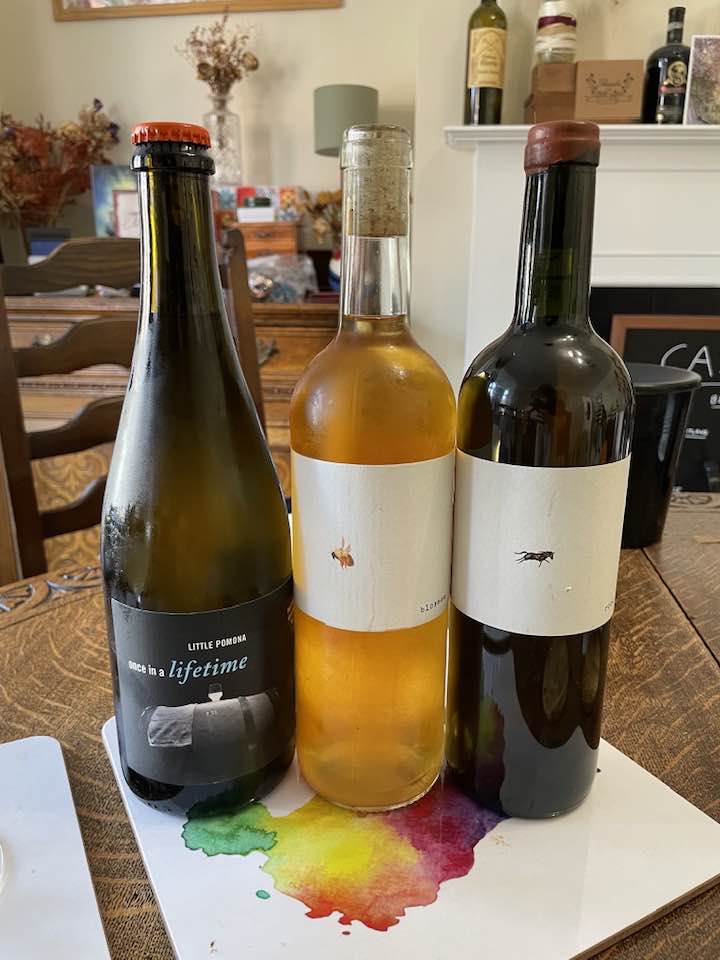
There’s a kind of honesty to dry, still cider or perry.
No, that’s not quite the right word. ‘Honesty’ implies that there is a dishonesty to other styles, which is plainly neither fair nor true. What do I mean?
I suppose I mean there is an openness to them; there is nowhere to hide. Stealing a quote from A View From The Bridge, which I believe I may have used somewhere before because I’m clearly That Sort Of Person, they ‘allow themselves to be wholly known’.
Sugar and bubbles are often wonderful things in a cider or perry, but they can also be great flatterers. They add body and texture to a drink; fizz can sometimes perform a little of the role of acidity in bringing a drink to life, adding zip and lift, whilst sugar can mitigate the more astringent impacts of tannin, broaden mouthfeel and even mask a little faultiness.
Without these crutches, dry still cider and perry is entirely exposed. The choices and handiwork of the maker in terms of varieties, fermentation, yeasts, maturation and the care offered throughout are all the cider has to stand on. The coarser bittersweets will be in full tannic song, so fruit selection and tannin management through maceration and requisite patience (or lack thereof) will manifest in the liquid without check. If a cider or perry is unpalatably sharp, there’ll be no sugar to cushion its attack on the gums. And of course — indeed more commonly, in my view — the reverse is true; if a cider has insufficient structural components, particularly if it is low in acidity, it will come across to the drinker as a bit lifeless and dull; a scenario that, in tandem with the huge prevelancy of sparkling cider, has cultivated a cultural tendency in the UK to mistakenly refer to a lot of still ciders as ‘flat’.
Although still and dry is the entirely-accepted norm when it comes to wine, wine has the significant advantage of (for the most part) markedly higher alcohol and acidity, ensuring both body and freshness. Still cider and perry, clocking in (when fully fermented) at around a half to two thirds the strength of wine is far harder to make. It is in this category that the floated truism that most apples aren’t inherently suited to making single variety ciders holds the most weight. Deprived of sugar and the buoyancy-aid of bubble, all deficiencies are laid bare. In the circumstances it’s understandable (although rather sad) that the default is often to sweeten or flavour or force carbonate.
It’s my feeling that still, dry cider is the hardest style of all to nail, is where the best producers truly distinguish themselves and is therefore the style for which, in the bottom of my heart, I have the greatest respect. Traditional methods, keeves, ice ciders, mistelles and so on all bring me out in giddy purple prose aplenty, but looking back it tends to be when I am presented with a dry, still cider or perry, a drink that offers nothing but the contrived confluence of fruit and trees and land (and, admittedly, often a bit of oak) that I start waxing misty-eyed about soul. They are the ur-cider: the root from which all other styles have sprung, and I’m always an inveterate sucker for the most seemingly-simple things done well. Returning to A View From a Bridge, and paraphrasing just a tadge: ‘because they allow themselves to be wholly known, and for that I think I will love them more than all the sensible ciders’.
But because dry, still cider is the most basic of all cider styles, it sometimes seems to me that it’s the least-hyped and the most overlooked, as eyes (often including my own — I’m just as guilty) are drawn to the flashy new shiny stuff like jazzy co-fermentations and fancy fizz.
So, following my recent two cheers for the mighty bittersweet here’s a small ‘hip hip’ for all things still, dry and made entirely from apples.
I’m kicking off in Scotland with the successor to one of my favourite ciders of last (or any) year — Naughton’s Homage to Hogg. The 2020, a single variety Yarlington Mill aged in former vin clair barrels from Champagne was one of my all-time favourite iterations of one of my all-time favourite apple varieties. I’ve since been lucky enough to meet the maker, Peter Crawford, an absolute whirlwind of enthusiasm and innovative ideas, who also happens to be one of the foremost experts on champagne in the UK and indeed the world. I’ve tasted a few of his traditional method works in progress and will simply say that I cannot wait for them to become commercially available; in the meantime I’m looking forward immensely to the Homage to Hogg 2021.
Like its predecessor it’s dry, still, fermented with wine yeasts in stainless steel and then matured in former vin clair barrels (Peter describes his style as ‘very reductive’); unlike the 2020, the new vintage is a single variety Kingston Black. Famously cider’s most talked-up variety, it’s a bittersharp apple (has both tannin and acidity) behind at least a couple of articles we’ve scribbled here previously, and whose finest examples have unquestionably made some of the best ciders we’ve tasted. Naughton’s is on The Cat in the Glass for £15.95 a bottle, at which price it needs to occupy rarefied territory indeed. My notes come from a bottle shared by Peter himself at the London Cider House.

Naughton Homage to Hogg 2021 (Kingston Black) – review
How I served: Lightly chilled. (Could go colder but this hadn’t been in the fridge long)
On the nose: Very pure, tense, concentrated nose though rounded with a beautiful, creamy Kingston Black butteriness. Soft apple and very fresh apricot. Utterly clean and the barrel influence really only manifests as a softening of the fruit, rather than offering much flavour from the wood. Frangipane and sweet pastry. A very elegant nose.
In the mouth: Follows on beautifully. Very ‘vinous’; soft with juicy acidity and the lightest, velvety tannins lending structure. Again very creamy but the freshness of apple and white peach fruit keep things taut and refined. Has very pure Kingston Black character and the lovely in-mouth perfume so distinct to this variety.
In a nutshell: Elegant, spotless, refined cider at the start of a happy journey. Wine influence is clear, whilst allowing the apple to be itself. Worth the entry fee.
Next up is one of my historic favourite makers of still dry cider. I’ve reviewed 46 of Little Pomona’s creations to date, so it’s safe to say I’m fairly familiar with their handiwork, and the cider I’m considering today is from another favourite variety of mine — Egremont Russet. Though based in Herefordshire, Little Pomona have established a significant love affair with this classic Eastern Counties variety, evinced by last year’s tasting of five stellar examples from their stable.
So when they release a bottling of a single barrel Egremont Russet called ‘Once in a Lifetime’, whose label features the most unequivocal of encomiums (‘utterly perfect in every aspect’ being perhaps the boldest), I think it’s fair to raise an intrigued eyebrow.
Whilst I’m not generally a fan of label hyperbole if it’s to the detriment of other ciders (‘you’ve never tasted a cider like this’, ‘this isn’t cider as you know it’ are two recidivist teeth-grinders) my hunch is that in this instance such seeming lavish self-praise is more a reflection of Little Pomona’s feeling that this single barrel was almost a fluke of nature; a literal ‘once in a lifetime’ coming together of one perfectly matched pressing and cask. In this instance Egremont Russet and a white burgundy barrel. Bottles have sold out on their website but are £14.95 on The Cat in the Glass. The price of perfection? Let’s find out. It’s got a high bar to clear to beat their previous Egremont editions.

Little Pomona Once in a Lifetime 2021 – review
How I served: 45 mins out of the fridge. ‘Cool’ rather than cold.
Appearance: Hazy straw. Still.
On the nose: Huge aromatics, even by Egremont’s mighty standards. A massive nose that manages to simultaneously be both generous and perfectly poised. Has every hallmark of this variety; almond and marzipan, check. Ripe and dried apple flesh, check. Melon, check. Light earthiness, check. Star anise, check. Lacings of vanilla, check. Indeed it’s less that this barrel has gone in some new, undreamt-of direction of flavour and more that it has turned Egremont’s classic flavours up to 11. In short, it’s a knockout.
In the mouth: Massive, textural Egremont Russet delivery. Immensely full-bodied – tannin, who needs it? (I’m joking, I’m joking, leave me alone) – with enough acidity for freshness but not so much as to be at all distracting. Then just enormous flavours of dried apple, almond skin, fresh melon and savoury, earthy spices. I’ve no doubt the barrel is contributing but to me this is all about the heightening of that outstanding variety to its zenith. Fair play Little Pomona; this is an ecstasy of Egremont.
In a nutshell: The Egremont Russet you’d use to explain Egremont Russet. A world class cider vying with Old Man & The Bee 2020 for my Little Pomona of the year so far.
From a maker to whom still dry ciders are a stock-in-trade to one who is approaching them for the very first time. Devon’s Find & Foster have serious form for fizz; I’ve written about them here and here and here and an old vintage traditional method featured in my first ever set of cider reviews here. Though I’ve not written it up in these pages myself, Jack raved about their Mêlé in our year-end writeup and from my point of view it’s probably the best drink ever committed to a can.
But still Find & Foster is a new one on me, though I’m very late to the party in that respect, as the pair of bottlings on the tasting table today have been doing the rounds for some time. I have in mind I had a taste of the Root at last year’s Cider Salon and thought it was jolly good, but such events are really only good for the most fleeting and basic of impressions.
Anyway — both are blends of several varieties; Blossom being a multi-vintage cuvée mainly from ‘acid-led’ apples and Root being from more tannic bittersweets harvested in 2018 and aged for 18 months in French oak. Two very different but equally exciting propositions then. The former will cost you £14 directly from the cidery’s website or £14.95 from The Cat in the Glass, the latter £15 from Find & Foster themselves or £15.95 from CITG.
With the final aside that if I love the ciders half as much as I love the packaging I’m in for an absolute treat, twice more into the still, dry breach dear friends, twice more…

Find & Foster Blossom – review
How I served: Chilled, as directed by the label. (Thanks, label!)
Appearance: Hazy honeyed gold. Still.
On the nose: Full, developed aromatics. Richer than the label suggests, perhaps because I’m opening it some time after it was bottled now. Summer flowers, potpourri, orange zest and victoria plum. It’s a heady, almost perfumed aroma; incense-like nearly; fragrant woods and blooms. The idealised version of a summer’s walk on a very warm day when the scents rise from fruits and flowers and woodland alike. All underscored by a flinty stoniness.
In the mouth: A marvellously classic Devon dry cider delivery in the sense that there’s a real firmness to the underlying structure of acid and tannin which here has been beautifully balanced by fleshy, juicy, orangey fruit, such that what could have been (and often is) austere is instead a refreshing touch of moreishly bittering pith. Flavours are broad and complex whilst still bright and crisp; tangerines, dandelions, blossoms and richer blood orange. It’s a beautifully crafted example of a Devon cider.
In a nutshell: Fresh and fragrant, sure, but with the complexity and structural weight for a gluttonous, charcuterie-heavy summer picnic. A gastronomic cider for fans of good orange wine.
Find & Foster Root – review
How I served: Room temperature (Label’s advice again. More ciders should offer such direction, as we’ve remarked before in our digital echo chamber)
On the nose: Gosh that’s a deep and hefty autumnal cider nose. All about the bass; a sonorous roll of dried orange, dried leaves, nutmeg, cloves, spiced apple, bark polished wood and a distant, reddish tint of apple skins and dried strawberry. Wants time and decanting to open up fully, and richly rewards such. Huge, orchardy sense of sous bois; I sense myself around old wooden presses and slumbering casks. This is what you feel so-called ‘farmhouse cider’ really ought to be, but so seldom actually is.
In the mouth: ‘Drums, drums in the deep’, intones this delivery solemnly. Just a full, baritone rumble of idiosyncratically Devon phenolic and I love Find & Foster for leaning into that, for allowing these apples to be what they are, and I am in awe of the sheer, ripe, full-bodied juiciness they have coaxed over all that tannic heft. So often apples like these can express as coarse and astringent; this is rich and stately and speaks of painstaking fruit selection and exemplary patience. Deep, deep spiced apple juice and dried orange and orchard floor and old wood and savoury spice. A cider to marvel at over a winter roast.
In a nutshell: Cider’s answer to an old master. A love letter or old Devon orchards and bittersweet apples.
Conclusions
Deck slightly rigged, admittedly, since these are three of the best makers of dry, still cider in the UK, but I’m certainly not left disappointed. Good Kingston Black is always a pleasure, and Naughton’s comfortably hits that brief. The two Find & Fosters sit in ‘make my heart happy’ territory as the most beautiful understandings and encapsulations of their places and fruit, whilst Once in a Lifetime does what it says on the tin as far as Egremont Russet is concerned. Thought it was the best ER I’d ever had when I did my tasting — came back to the rest of the bottle a few hours later and found it had opened up into something even more spectacular. Little Pomona really are on blistering form recently, and as good as their co-ferments and experimentations are, it’s the all-apple creations which, for me, are pushing the envelope on pure technical excellence. Maybe I’m just an apples-only snob at heart, who knows?
Ciders like these make me both sad and ecstatic.
Sad because they make me ask for the umpteenth time why people; intelligent people capable of reading books and in possession of their own taste buds; are so wilfully smug and sneery and snooty and condescending about cider when it is capable of such absolute magic; when its fruit offers a richer, broader tapestry of flavours than anything else grown or made in the UK. Sad that there are still so many ciders on shelves that contribute to this patronising assessment; this doing-down of cider; whether by faults or by excessive artificial sweetening or by using as few apples as legally permitted in the name of efficiency and capitalist cynicism. Sad because it is still so little-known that drinks of this calibre exist within the category, even by people living within a slingshot of where they are actually made. Sad that there may be people who might read this, even people who consider themselves great lovers and champions of cider, who will make righteous noises about ciders getting above themselves with wine-style bottles and aspirational prices. Sad that all too often drinks like these simply don’t get a chance. Sad that when I say I worked in wine or work in whisky people say ‘ooh’, and when I tel them I write about cider they say ‘oh?’ Sad at the stupid, thoughtless, senseless unfairness of it all.
And yet despite all that they are made, they do exist, these beautiful, marvellous, mind-broadening, game-changing things made of apples and yeasts and trees and land and time and human decisions and nothing else. They’re there on shelves, little bottled miracles waiting to be unearthed. And you know what? They are on the rise. They are increasing in number. There are without the faintest whisper of a doubt more brilliant ciders available — by a country mile — than they were when I first got into this sort of cider just under a decade ago. More than there were when I wrote my first article in September 2018; more than when I started writing regularly about them at the turn of 2020. And more people are discovering them too.
But it’s not enough to want nice things, or for nice things to exist in small numbers and tucked-away places. We have to buy them and shout about them and then shout about them some more. The age when we were all drinking at home and when so many people were discovering this format and quality of cider is long-since behind us. The pub is once again behind the bulk of cider consumption — and goodness knows pub cider needs all kinds of addressing — it’s up to us to make sure that ciders like these don’t fall back five years again. They are too special, too compelling, too delicious to lose; these essences of orchards; these apogees of apples.
Discover more from Cider Review
Subscribe to get the latest posts sent to your email.
 Cider Review