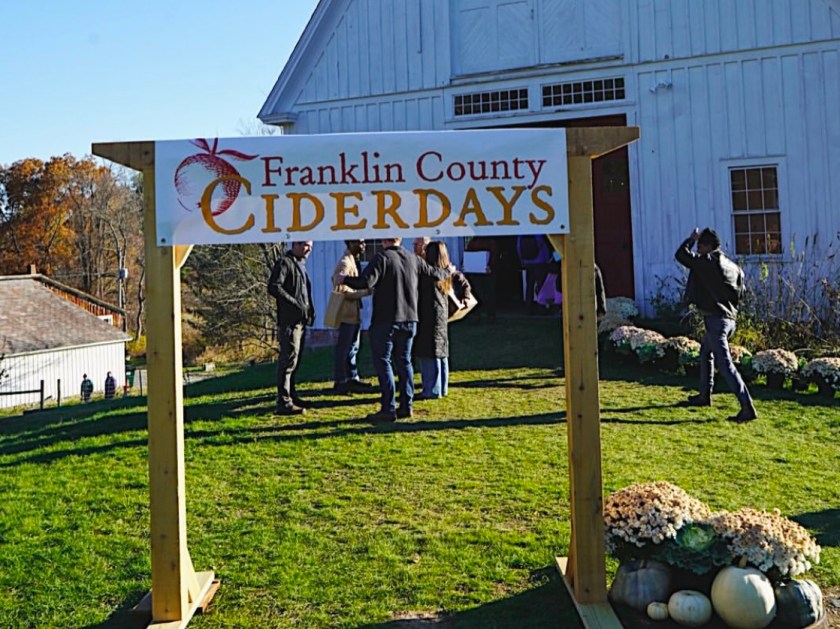
When I was younger my family briefly lived in Massachusetts, and it was there that I formed what is now my personal archetype of a true “autumn” scene: late October/early November, the visual of ancient maples dropping their blazing hues to reveal skeletal structures, a starkly sunny day with the tactile sensation of crisp cool air on rosy cheeks, and of course the smells of an orchard: ripe freshly harvested fruit filling bushel boxes and bins, newly decaying leaves and soil getting ready for a winter’s sleep. A couple of weeks ago when that air on my cheeks and that specific orchard aroma was back, it was like church bells awakening my lizard brain, and I knew I was back in Massachusetts. It was Franklin County Cider Days time of year!
Many UK and European readers would be surprised to learn that here in America we have a cider festival celebrating its 31st year. Though it has not had the most continuous format in recent years in part due to the pandemic, organizers this year really brought back a sense of tradition, community engagement, and excitement for cider and apples in the northeastern States. Called Franklin County Cider Days because it started there and largely takes place in and around the orchards of Franklin County in western Massachusetts, it also includes participants from the surrounding areas of the Berkshires, the Pioneer Valley, central Massachusetts, and southern Vermont. Most attendees (as will I for the rest of this article) just call it “Cider Days.”
It’s a giant three-day weekend dispersed over dozens of venues that includes anything from cooking demonstrations to pruning workshops, plenty of cider of the juice/unfermented kind (unfortunately still the dominant meaning of the word for most Americans), and of course cider donuts. It’s impossible to attend everything, (or review dozens of sampled ciders), so here are some impressions from a few key cider-focused events of the festival.

The weekend began on Halloween Friday at the Williamsburg Grange Hall, where the Pomological Exhibit marked its sixth year. Started by legendary orchardist Matt Kaminsky (also known as Gnarly Pippins online), and described by him as a “wild ruckus and public service to the pomological community,” this has now become the traditional starting event for Cider Days. It is an impressive annual collection of wild and seedling apples and pears submitted by orchardists and fruit explorers from mostly New England, but also from as far as Canada and California. I’ve attended four of them now, and each time the crowd is a little larger, a little livelier (both the people and the apples!). The range of submissions in earlier years might have been more eating apple heavy, but this year I felt included the most tannic apple varieties and most pears ever. Plenty of diversity was also on display in terms of skin color, shape, russeting, sugar and acid levels, crazy aromas and flavors. Most importantly it is a tasting experience! Participants are encouraged to taste the fruit, write tasting notes (eg “peach yogurt”, “handful of oak leaves”), and vote on different categories such as Best Eating, Best Cider, Best Pear, and Best in Show. The idea is to discover new varieties that were born from, and thrive in specifically American terroirs – AND build the community that shares them and propagates them. Luckily, each year Kaminksy publishes a book with the results: truly a modern pomona publication with detailed standardized descriptions of the winning varieties and stunningly beautiful apple portrait photos by William Mullan. A very important and honorable undertaking for the future expression of American cider terroir. The “PomEx” reminds us just how endlessly variable the apple can be, but also that the consumer will never know unless there is a strong community of orchardists and cidermakers that bring these new varieties forward.

No Cider Days would be complete without a visit to the hilltop tasting room at West County Cider in Colrain with its fifty-mile view of the valley below. Founded in 1984, it is easily one of America’s oldest and most influential cideries. There is almost no tannin in most of the ciders they produce, and it’s conventionally produced (commercial yeast, filtered, usually off dry), but they were the first to celebrate single varieties and illustrate you can make delicious ciders from the American heirloom varieties grown locally, especially Redfield, Baldwin, and Roxbury Russet (a Massachusetts variety from the mid 1630s!), which were on hand Saturday afternoon. During the weekend they also had freshly shucked oysters, and hosted a local home cidermakers bottle share. There was even a troop of Morris dancers! This (and their name) may be a tip of the hat to the heritage of England, but West County is very much a local place steeped in the apple history of New England. A highly recommended stop for any cider pilgrim.
Saturday also featured a series of talks in Shelburne Falls (perhaps the most scenic town in Franklin County) at Raven Books. A stand out was master orchardist Kevin Clark of Rose Hill Farm (in the Hudson Valley New York) who presented his remarkable “Pomona’s Gifts” display—more than two hundred apples, some old world cider varieties, many American heirlooms, and also some more newly propagated seedling varieties finding traction with contemporary orchardists. He took this panoply of apples (a panappley?) on a multi-state tour in the couple weeks around Cider Days. Imagine Jim Chapman’s perry pear collection on display not just at the Malvern Autumn Show but also traveling to Birmingham, Gloucester, Bristol, etc. I think this was a fantastic way to educate the general public about the diversity of apples and to get them to be more curious in their cider consumption as well. Each apple was labeled and wrapped in individual paper bags during transport to keep them straight – a lot of work!
By Sunday morning, my anticipation was high for the Cider Salon, in my mind the weekend’s centerpiece. Tom Oliver has credited the Cider Salon at Franklin Cider Days as an inspiration for the thriving Cider Salons now taking part regularly in the UK. One of the longer-standing traditions of Cider Days, the Salon had been on hiatus for a few years, and the energy felt amongst attendees at this year’s revival was palpable. The setting this year was not actually even in Massachusetts, but in a charming old horse barn at Scott Farm in Dummerston, Vermont, just across the state border. Scott Farm is one of the best orchards in the country and supplies many cidermakers in the northeast with their own impressive panappley of varieties, so it was a very fitting venue.
The format was two one-and-a-half hour tasting sessions in the afternoon, with no hard and fast entry criteria, but the majority pouring were small-scale, harvest-based, naturally fermenting producers. Massachusetts makers like West County and Berkshire Cider poured alongside those from farther afield: Maine, Connecticut, New York, even Michigan. Some familiar names were Eden, Wildbranch, and Fable Farm from Vermont, and Eve’s and Aaron Burr from New York. New-ish discoveries to me were Uncommon Kin Cidery from the North Catskills NY (crispy site-specific wild foraged ciders) and Absolem Cider from Maine (fantastic apple-grape-plum-peach coferment). In the corner, a couple fiddle players added to the festive bucolic charm of the event, but the music had a lot of competition from the boisterous conversation happening between makers and drinks. The place was buzzing.
What struck me most was the sense of fun at the Salon. In the parlance of our times, it was really good vibes. Producers relished the opportunity to share special creations in a more intimate, convivial setting. Those new to cider seemed welcomed, engaged, and curious. Conversation trailed into the parking lot where folks traded bottles out of their cars. The Salon felt not at all like a trade tasting event but much more like a communal toast to the end of autumn – and an acknowledgment of all that cider connects: the land, the fruit, the people and the culture.
This feature is inspired partly by Barry’s recent Cider & Community post. So much of discourse these days takes place online (cider-related or anything otherwise), and while people and ideas are connected more globally as a result (a good thing), there is nothing that can replace in-person celebrations. The ultimate form of sharing, as Barry says. Herefordshire or Normandy are places that have an extremely rich apple and cider history and culture. Massachusetts happens to be another place with a rich apple and cider history and culture. The best way of experiencing what these cultures (or anywhere else) have to share is to be there in person (second best is reading about it on Cider Review…). I can only hope Cider Days and its Cider Salon will continue to thrive for decades to come, and also inspire the establishment of more similar events elsewhere in America and around the globe (Hungary in April anyone?).
Here’s to an archetype of autumn that includes not just leaves falling, cool air, and orchard aromas, but also people gathering and sharing and celebrating at cider salons.
Discover more from Cider Review
Subscribe to get the latest posts sent to your email.
 Cider Review
lovely article Kris. It’s a dream of mine to attend Cider Days one year!
LikeLike