
This wasn’t how’s it was meant to be. At least not in my head anyway. Maybe it was my naivety or maybe just hubris, but I thought in its 5000+ year existence cider might have a rich untapped culinary history to unearth. I wasn’t expecting anything akin to wine of course, but I thought there’d be something there that would be more than enough to explore. As it turns out I was mostly wrong.
There was no world-famous dish that cider was synonymous with, nothing in the restaurant world like Monsieur Paul Bocuse’s truffle soup, or Pierre Koffmann’s stuffed pig’s trotter, nothing like Fergus Henderson’s roast bone marrow on toast with parsley salad, or Botrytis Cinerea, Heston Blumenthal’s The Fat Duck’s homage to the noble rot that gives Sauternes its distinctive characteristics. That’s maybe unsurprising, but a guy can dream, can’t he?
I turned to my old boss, boulanger supremo and Brittany native Richard Bertinet. I figured if anybody had some knowledge of old recipes involving cider it would be a Breton. We chatted about pork braised in cider, steamed mussels, braised leeks, using cider for a béchamel to put on top of scallops, roast guinea fowl with cider and creme fraiche, adding cider into a creme anglaise for serving with Apple Charlotte, adding to bread or soaking grains in for use in bread. All beautiful in their own right, but at the same time it’s mostly the usual suspects that you’d expect any time someone asks what food you should cook with cider. They’re dishes and combinations that haven’t exactly made their way into the public consciousness in the same way some regional classics have like the Cassoulet of Carcassonne, Castelnaudary & Toulouse or Cacio e Pepe & Carbonara of the Romana region, or closer to home something like a Lancashire hot pot or a Cornish pasty.
But why haven’t these dishes broken through? Take mussels cooked in cider for instance, a simple and tasty dish that would make an awesome and mercifully fast mid-week evening meal that you don’t need to be a chef to cook. Throw a bowl of fries on the side and you are as far as I’m concerned living your best life. I suspect the answer to the question is two-fold. Firstly, the good old general perception of cider. Cider in cooking is generally thought of as the ‘cheaper’ or ‘thriftier’ alternative. Why cook mussels in cider when you could use a more highly regarded white wine or something fortified like sherry or vermouth? The second, and I’m talking strictly about the UK when I say this, is widespread access to good cider to cook with in the first place. That’s obviously changed massively over the past ten to fifteen years, but still the options for pubs and restaurants, not just the general public have been classically limited. At the risk of having the accusation of food snob levelled at me (I am, it’s ok, I’ve made peace with it!), I can’t imagine cooking anything good with the likes of your standards like Thatchers or Strongbow, but if you’re here I’ll assume that the notion also makes you at least a little queasy. Macro-produced ciders aren’t really going to give you much flavour-wise and they’re certainly not going to bolster and become ingrained with a dish in the same way a crisp acidic Riesling would in a Choucroute Alsacien or a rich full bodied Burgundy would in a Boeuf Bourguignon.

Maybe even worse for pubs and restaurants is the availability of ‘cooking’ cider along with a range of other ‘cooking’ alcohols. A pretty tasteless low alcohol liquid that might make even the largest most unscrupulous of macro producers baulk at the water content. This more than anything is doing absolutely no favours for cider’s reputation in food, the most unbelievable part though is this quasi-cider with next to no alcohol and mostly made up of water is roughly the same price per litre as the cost of a decent full-juice bag-in-box, so it’s not as if it’s even the cheaper alternative. Like a Thatchers or a Strongbow it’s a product completely devoid of terroir, and I think that’s maybe the key to why some of the aforementioned dishes aren’t as well regarded, it’s not just a quality issue. For instance, the Riesling in the choucroute has terroir, it’s of a time and place, it’s of the region, the whole dish is a reflection of the place it was made. Without terroir a dish becomes unmoored, set adrift, decontextualised from its origins. Using poor cider devoid of terroir takes away immeasurably from the dish it’s used in, it uproots it from its tradition and history and goes a long way to explaining why a lot of the such dishes aren’t more highly regarded.
So not exactly a dead end, but not anything massively juicy to get my teeth into on the history front. No comprehensive deep dive into cider in food. But in thinking not just about cider but its expression of terroir in food it led me to a place unexpectedly close to home.
I’ve known Paul Burton for around three years give or take. As seems to be the way in hospitality, he’s someone the more you get to know the more you realise that you’ve worked at some of the same places, worked with some of the same people, moved in similar circles, so much so that you’re amazed that your paths haven’t crossed at some point sooner over the years. He’s without a doubt one of the keenest minds I know, and on the occasion when we do chat, conversations can get seriously niche. How does coagulation of meat proteins effect heat distribution through a terrine? Or how long does it take for collagen to break down into gelatine, anyone?! He reminds me most of James Forbes of Little Pomona not only in the unwavering devotion to their individual ethos’s or their laser-like focus on quality control and analytical approach to their work, but also like James the ability to always greet you with the biggest smile. Paul is also, without wishing to bury the lede any further, in my opinion the best Charcutier in the UK. His charcuterie is a beautiful reflection of Somerset, the West Country and, just like Charles Martel‘s legendary Stinking Bishop, it is pomme fruit that helps accentuate its ties to the land in which it was created.
Paul runs Westcombe Charcuterie at Westcombe dairy farm, not only home to the famous Cheddar that bears its name, but an ever-growing hub of like-minded culinary individuals. As well as cheese and charcuterie, the farm plays host to Landrace Milling & Bakery, Woodshedding Brewery & Beer Hall, Brickell’s Ice Cream and Firemade, a company that designs and cooks with bespoke open fire grills. Regenerative farming practices create a focal point or through-line between each of the separate entities that inhabit the farm. That ethos extends to sourcing the pigs for the charcuterie as well. The Tamworth Hampshire cross comes from Andrew Price near Exmoor on an estate that uses regenerative farming, agroecology and re-wilding practices.
I sat down with Paul late one Friday afternoon after our respective workdays had finished, and over a bottle of the latest iteration of Oliver’s Nuttiness & Whizz and an impromptu spread of his cured meats and pâté, we chatted about his history with butchery, charcuterie & food and how cider came to play a part in his work. It ended up being less of an interview per se and more of a convivial early supper.

Cider Review: Hi Paul, before getting straight into the cider, tell me a little bit about you background and how you came to charcuterie in the first place?
Paul Burton: So I started by having a Saturday butchery job before I’d left school, it got to the point where I could butcher a whole pig on my own. Then after school began cheffing and took that butchery approach to wherever I was working, buying in whole lambs and that sort of thing. Then over the course of, well quite a while now (laughs), in my working life I’ve been alternating between the butchery and cheffing, and through that process kind of always taking that understanding of one into the other to help elevate the other discipline, so the charcuterie ended up emerging as the bridge or the middle ground between those two. Then I got into the fermentation side of the charcuterie and that just blew my mind, I got really excited about that. I realised that ultimately, I liked watching stuff grow, and with the moulds on the charcuterie it very evident, and you can see that developing. Sometimes we refer to it as mould farming as that’s what we’re actually doing, because that’s the bit that makes it salami as opposed to just sausage. Then there’s that whole thing of the fermentation that you can’t see, but you can taste it, and you can smell it, and you can enjoy it, and going in on that’s microbial level to understand what’s going on I just found absolutely fascinating.
CR: So the charcuterie was always something you were making alongside or as part of the butchery and cheffing?
PB: Yes, I was already making charcuterie within the restaurants I was working in, and then had a few years when I was self-employed doing workshops and teaching courses, and then when I came here (Westcombe) and started running the shop I started developing a smoked cheese and lots of different little projects and one of the ones that kind of snowballed was the charcuterie. Then it was looking at what sort of stuff do we want to produce, and wanting to make something that’s in keeping with the cheese and can sit next to it happily and be consumed together, so very much going down that air-dried route with the charcuterie.
CR: What was the starting point then in trying to figure out how to develop the range?
PB: Well, we looked at the whole British charcuterie thing, which was really gathering some momentum at the time, but at the same time there was something that seemed slightly at odds about it because fundamentally what is British charcuterie? Really its stuff like sausages and faggots and hams rather than anything air-dried.
CR: So very French influenced products then, some might even say slightly bastardised versions of French products.
PB: Exactly, yeah. We were looking for something, some kind of heritage to an air-dried British charcuterie product. And scouring the recipe books and old history books, and even happened across a guy, a food historian named Ivan Day. I asked him about it, see if he could head any light on it, and he said there’s virtually no record of it. And so, it got me thinking, all this charcuterie that you get all over Europe, it’s all a response to the immediate environment, and so what in Somerset are we going to use, you know, what’s our palette? And in terms of something like booze, cider’s the obvious go to.
CR: Cider was the early front runner to use then?
PB: Yeah, whilst we’ve also got a beer heritage here, and there are some instances where beer works nicely. Think steak & ale pie and that kind of thing. Certainly, from a fermentation point of view you can end up with all the bitter notes come very much to the fore, and the hops can be quite problematic and things like that. And so cider is like a much more… it can be much more harmonious with food, and so that felt like it was the obvious way go to.
CR: It also feels a bit more analogous to the use of wine in similar French & Italian products.
PB: Yeah, yeah, exactly. A very similar product that you can use in the same sort of way.
CR: How is the cider being used then, because I understand it’s used slightly differently for each product?
PB: Currently we’re using the Malus from Beccy & Sam (Wilding) in the pâté, the Pomona from Burrow Hill in the Pomona salami and then in the Coppa and Lonza we’re using farmhouse cider again from Beccy & Sam. So different products with different qualities for the different applications.
CR: Have you had any challenges with using the cider?
PB: I think the challenges that we’ve found, in terms of incorporating it into the charcuterie is that, like the Malus for instance, it’s absolutely delicious drank as a drink, but then when you try to mix it with other things you get some quite wacky kind of reactions going on. We tried doing some Malus washed hams and some worked really really nicely, and then others had weird kind of Coca Cola flavours and some other wacky stuff showing up. But the Malus in something like a pâté where it’s a straight product without that fermentation element is absolutely delicious and provides that nice body and depth to the pâté.
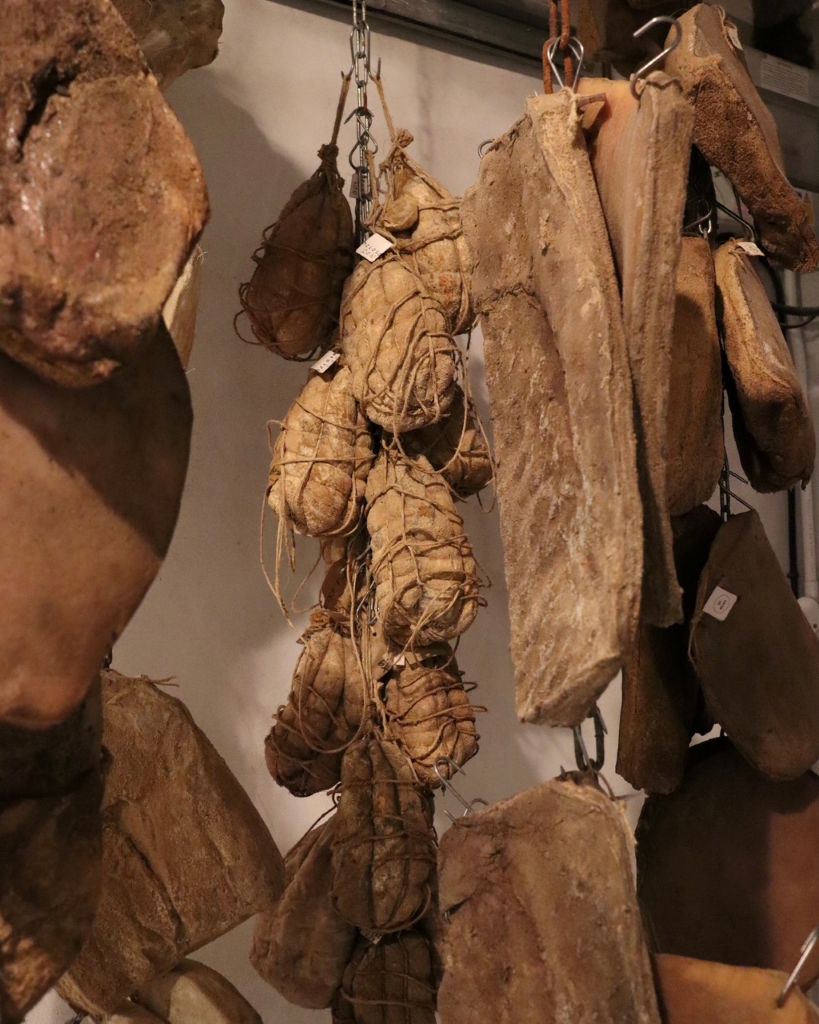
CR: I assume the higher ABV could potentially mess with the fermentation and mould growth as well?
PB: Yes, potentially it’s a possibility. And that’s something we touched on the other day, getting those apple-y flavours to show up through fermentation which is the big thing that we’ve had to deal with.
(I should note at this point the “other day’ that Paul is referencing was another rabbit hole we fell down whilst trying to organise the interview over WhatsApp. He mentioned that an interesting topic for discussion was the difficulty in getting the apple flavour through the lactic fermentation that the salamis undergo. This led to a little back and forth of hypothesising why this might be. Possible malolactic fermentation occurring alongside lactic fermentation? Lactic & staphylococcal fermentation breaking down the apple-y-ness down into other products? The exposure to oxygen/oxidation accentuating the volatile phenols in the cider? The production of Diacetyl blending the more dairy notes in with the fat of the meat? Or naturally occurring nitrates in the meat causing a breakdown or complete decomposition of the Butyl acetate, hexyl acetate, 2-methylbutyl acetate, and ethyl 2-methyl-butanoate which are the main flavour components in apples? Or some sort of cascade effect of some or all of the above? If there’s someone out there who can shed a bit more light on this phenomenon then we’d both welcome the input.)
PB: The Pomona is a much more stable product and stable flavour, so by steeping the green peppercorns for the salami in that it brings out the fruitiness in them, and kinda almost encapsulates it and you get a really nice salami from it, but it doesn’t taste that apple-y. But it’s like you know, do you want everything to taste of grapes that you put wine in?
CR: Yeah absolutely, you wouldn’t think of something like a Bresola being red wine necessarily.
PB: Yeah, you wouldn’t think um, this taste of grapes, it’s the just the flavour of Bresola, red wine is just one of its elements, a sum of its parts. But I think definitely with the Pomona it adds to that fruity, herby thing going on in there. I think the Coppa is probably the one, that certainly as we’re tasting each batch as we’ve opened them up, I’ve noticed the kind of vinous, cider-y flavour be most apparently.
CR: You’re actually using the farmhouse cider in the case of the Coppa to wash the outside once it’s been cured?
PB: Before we started washing it with the cider we were finding we were getting some very very salty Coppa, and then I came across something in a book somewhere that was saying actually there’s some places in Italy that they wash it with wine to knock back that saltiness and lift that excess salt off the surface. And again it was if we’re going to do that here why would we use wine? We’ll use cider because that’s what’s near us. So thats been very much the approach and mentality that we’ve taken towards it. Once they’ve finished curing and before we tie them, we basically douse them in cider and turn them for six hours, just washing off a little of that excess salt but then obviously that cider’s travelling in at the same time. Then they equalise in the casings for a bit before being fermented, so they’re essentially steeped in cider.

CR: How did the relationships with Burrow Hill & Wilding come about in the first place?
PB: So Burrow Hill was for a long time, when I first started here, the only people we stocked in the shop apart from Wild Beer that wasn’t Westcombe produce, and Tom (Westcombe’s creative driving force) had known them for a long time, so that just felt very natural to use what we had already. And Sam & Beccy I’d known since before they were setting up Birch, because they used to come in and buy meat from me when I was working at Source deli in Bristol. And when I was doing Saltbox, which was my freelance thing, I actually did some of the workshops at Birch which kinda cemented our relationship.
CR: I have to say the pâté is really good by the way.
PB: It’s kinda nice once you’ve done the recipe or the recipe development long enough ago and then you can just enjoy it for what it is. It’s really enjoyable because I’ve designed it to taste like the stuff that I like (laughs)!
CR: At one point you were playing with using the pectin gel that was racked off from the Malus to use as a wash, weren’t you?
PB: Essentially yes, we were trying to wash hams with that, but we were getting, especially with the surface of the hams and the pellicle on the it at the end of maturation, we got some really funny flavours coming through, and some where great, it just was a bit too inconsistent so we ended up shelving that idea.
CR: How did the idea for trying the pectin gel come about in the first place? It doesn’t seem to be the most obvious thing to set about using and I guess it caught my imagination because it’s effectively using a waste product from production.
PB: I mean that was, I suppose, a conversation with Sam and saying I’d really like to use the Malus, but obviously it is excruciatingly expensive to be splashing around everywhere. And he said well actually at the bottom of the barrel we get this pectin gel along with the sediment, so we could sell you that at a better price. I don’t quite understand the law on it but because its then food grade rather than consumption as a beverage the duty is different, so we can pay a very sensible price on it.
CR: How are you finding the Oliver’s we’re tasting pairing up with the charcuterie?
PB: It’s delicious, a lot of body to it, but still very easy drinking it marries up really well. I think it’s like with all of these things, you want to have nuance there that if you take the time to look it’s there, and without trying to sound too wanky you can go on that kinda flavour journey, but you don’t want it that full in your face that you can’t actually just enjoy drinking it, you know summer night and chatting etc, do you know what I mean?

CR: Absolutely, a Friday night with a glass of something like this without having to sit there and pontificate on it.
PB: Without being too serious about it, absolutely!
CR: Paul, thank you for your time and thank you for putting on such a great spread for us.
PB: You’re welcome. Thank you.
Between Westcombe and Wilding, they’re really the two places that I started to better understand the idea of terroir after first visiting them. With Wilding, if you’ve ever visited their farm or the cidery itself, it’s hard not to think of those places and recognise them in their ciders. Likewise, if you’ve ever visited the cheese cave (yes, an actual cave of cheese!) at Westcombe you get a sense of it and the place when you taste the cheddar. And although the cheese and charcuterie are housed in different buildings on the farm for obvious reasons, and with the addition of an onsite bakery, I can’t help but think that there’s a lot of mutually beneficial bacteria floating around the farm landscape making each product uniquely its own but adding to each other in a way that elevates all of them. The terroir of Burrow Hill and Wilding’s respective orchards only adding to that in their own distinctive ways.
Like Paul’s search for a history in British charcuterie, my search for some history with cider within cookery proved scant. But maybe we’re at a point in time where that will change. Maybe by embracing the idea of terroir and a respect for what is around us like Paul has will lead down a road that becomes a history of sorts. Maybe we’re at the start of something, and that could be as an exciting a search as anything else.
Cover photo: Paul Burton at work. Photo by Ed Schofield.
Discover more from Cider Review
Subscribe to get the latest posts sent to your email.
 Cider Review
Nice choice of Nittiness & Whizz and if no culinary tradition exists, then, as you are doing, let’s build one, dish by dish. The cider is now coming good for this.
LikeLiked by 1 person
Pingback: Craft Cider vs. Craft Beer: Where Are the Trends? | Cider Review