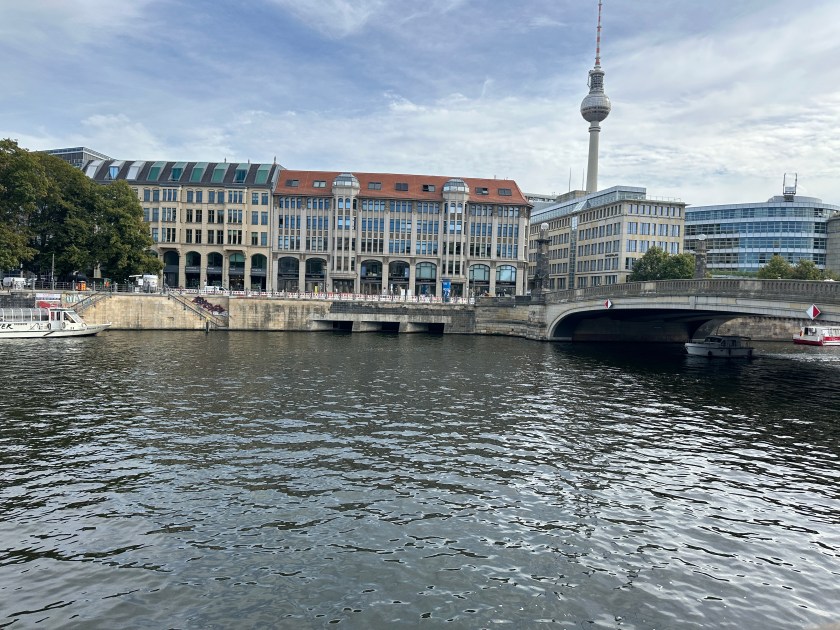
Continental Europe is dotted with cider Meccas: San Sebastián and Oviedo in northern Spain’s sagardo/sidra country spring to mind, as does Frankfurt with its Apfelwein. A major city that’s less likely to feature on a cider-focused itinerary is Berlin. Depending on your perspective, it’s either not a cider destination, or perhaps up-and-coming one (especially since the exciting inception of the Berlin Cider Club) — or indeed a cider destination by default, as you can find most anything in Berlin.
Famously creative, edgy, and multi-cultural, Berlin is a melting pot that Germans habitually describe as being ‘nothing like the rest of Germany’. And we’re not just talking about the many people from other countries that settle there — it’s the drinks, too.
My partner recently watched a YouTube video for German learners which interviewed young German passers-by on the streets of Berlin. It was striking how almost every single one was quick to praise the beer brewed in their hometown (all outside Berlin), and then to state that they regularly seek out the bars and shops that sell this beer in their new cosmopolitan home. It turns out that Berlin is also a melting pot of beer preferences; it’s a microcosm of German’s fiercely regional brewing heritage.

So, I had established that people care about their drinks in Berlin. Looking into the city’s drinking heritage, I was surprised to find that Brandenburg, the state surrounding the city-state of Berlin, was once wine-growing country; production peaked under the Prussians in the early modern period but hung on into the 20th century.
Moreover, as all German children know, there is fruit-growing heritage in the ‘Havelland’ just west of Berlin: in Theodor Fontane’s classroom stalwart poem of 1889, Herr von Ribbeck auf Ribbeck im Havelland (find an English translation here), a kindly old man gifts fruit from his pear tree to passing children and, in the end, gives new meaning to the phrase, ‘Pears for your heirs.’ A lot of fruit for the table as well as juicing and preserving is still grown in the Havelland region.

All that said, there are far more mentions of the sour beer style of Berliner Weisse on Cider Review than of the city of Berlin, so I took much of my Berlin cider itinerary from Natalia the Cider Explorer and her excellent 2019 article on where to drink and buy cider in Berlin.
Incidentally, I think Natalia is too hard on her home base. She does call it ‘the best city in the world’, but she also says you can find ‘everything but cider’ here — and then proceeds to list 20 cider-purveying bars, restaurants, and shops! I have a feeling that more will join their ranks.
The first cider on my little tour of Berlin was one I was particularly keen to try: the cider at Hops & Barley microbrewery in trendy Friedrichshain, the only place on Natalia’s list to make and pour its own cider.

Hops & Barley Cider – review
How I served: Cold, in a narrow, rather ungainly (from a nosing perspective) 0.3l beer glass.
Appearance: Surprisingly rich and hazy gold — is this a tannic cider? — with an oddly beer-like head.
On the nose: Malic acid sharpness followed by persistent sulphur. A bit ‘home brew’-esque.
In the mouth: The same flavours as on the nose, but with the off notes dialed back and a nice juicy freshness added. It certainly seems like it’s still fermenting. Unfortunately, it has some of the metallic harshness I associate with Trierer Viez (very happy to be proved wrong on this, incidentally!).
In a nutshell: Fun but unsophisticated; not something I’d likely choose to drink outside the brewery.
I agree with Natalia on this one; the Hops & Barley cider was not my favourite. When I asked the people at the bar where the apples for their cider come from, they said that it used to be made with concentrate from England, but that stopped being possible with Brexit, and now they weren’t sure how it was made.
If this account is true, it’s disappointing. However, to the contrary, Natalia was told that they make the cider from fruit grown around Berlin; she hopes to get confirmation from the cider-maker sometime soon.
Either way, it seems Hops & Barley are justifiably proud to be perhaps the only brewery in Berlin making its own cider; it was worth the visit.

Later that same day, I headed to the Muted Horn, a bar warmly recommended by Natalia. Any misgivings I might have had about Berlin’s drinks offering were immediately assuaged: this was a 22-drink-strong tap list like I’d never seen. Red wine barrel-aged bretted wild ale brewed with Pu-erh tea, anyone? How about sparkling session mead infused with prickly pear? I’m a sucker for this kind of stuff — as long as it doesn’t stray into ‘popsicle or ‘candy corn’ territory.
I forced myself to steer clear of the pathologically interesting beers and went for the single cider on tap, Revel’s All Day (‘Dry & Wild Blend of Strawberry & Lavender Apple cider + Apple Cider Macerated on Whole Red & Blue Plums’). As Natalia notes, Muted Horn regularly has Revel products on tap and on their unsurprisingly extensive bottle list, but this was my first Canadian cider.

Revel All Day – review
How I served: Very chilly, in a bulbous Belgian beer glass.
Appearance: Light, all-but-clear garnet colour — it was macerated on whole plums for 8 months, after all.
On the nose: Strawberry, strawberry (pulp), strawberry (jam), strawberry (candy). Okay, and fermenting plums. Over time, the aromas meld and mellow into marshmallowiness.
In the mouth: This is Big Strawberry (at the expense of the apple, admittedly). On the palate, it’s not actually sweet — which certainly adds interest given this cider’s flavour profile. Still, it’s hard to stop drinking something so berried and juicy. Its high acidity is reminiscent of a fruited sour beer, but it doesn’t have the heft of grain. The lavender is there, but it’s super-well integrated; it’s a great foil to the strawberry flavour.
In a nutshell: This does what it says on the tin (well, on the 750ml bottle or keg), and it’s ultra-crushable while being sophisticatedly summery. However, it’s more strawberry than apple, and strawberry is not the most complex of fruit flavours.
With a slogan like ‘fruits, flowers, and feelings,’ I’m getting a Brutes-like energy from Revel. Indeed, they describe themselves as ‘an exploration of fruit and botanicals for the modern drinker, always wild-fermented’, and their branding is as natural wine as they come.
Revel is a producer I’d like to explore more. I wish I’d been able to come back for the ‘Dry & Wild Farmhouse Cider w/ Pears & Dolgo Crabapples’ which was up next on the Revel tap and sounded like potentially more my kind of thing.

So far, I had experienced unfiltered, still-fermenting cider made by a relatively trad microbrewery and the exotic cider offering of a super-craft beer bar. My drinking time in Berlin was limited — I was supposedly there to attend a conference — but I managed to squeeze in a couple of bottle shop visits before leaving.
First, I procured a tiny David Bowie-themed Fruktstereo cyser (I do love a cider-mead hybrid), which was one of two ciders on offer at MORE Natural Wine. Then, I bought a 750ml bottle of Breton cider with a reassuringly medievalising font from a Francophile delicatessen in which everyone — staff and customers — was conversing in French.
Fruktstereo The Fall and Rise of Cider Stardust and the Honey from Mars – review
How I served: From the fridge, in little whisky tasting glass that seemed to befit the diminutive bottle.
Appearance: Utterly cloudy straw.
On the nose: Lavender, honey and beeswax, apple cider vinegar, melon soda.
In the mouth: The palate is like the nose: fresh, punchy, acidic-verging-on-acetic apple just balanced by rounding floral honey notes (that will be the ‘local spring honey from Höör’ in southern Sweden which the apples were co-fermented with). The volatility is balanced by the meatiness of the finish, and a persistent bubbliness keeps things light.
In a nutshell: If you don’t mind the acetic (I’ve seen Fruktstereo described as ‘hard kombucha’), this funky-fresh floral number slips down very easily.
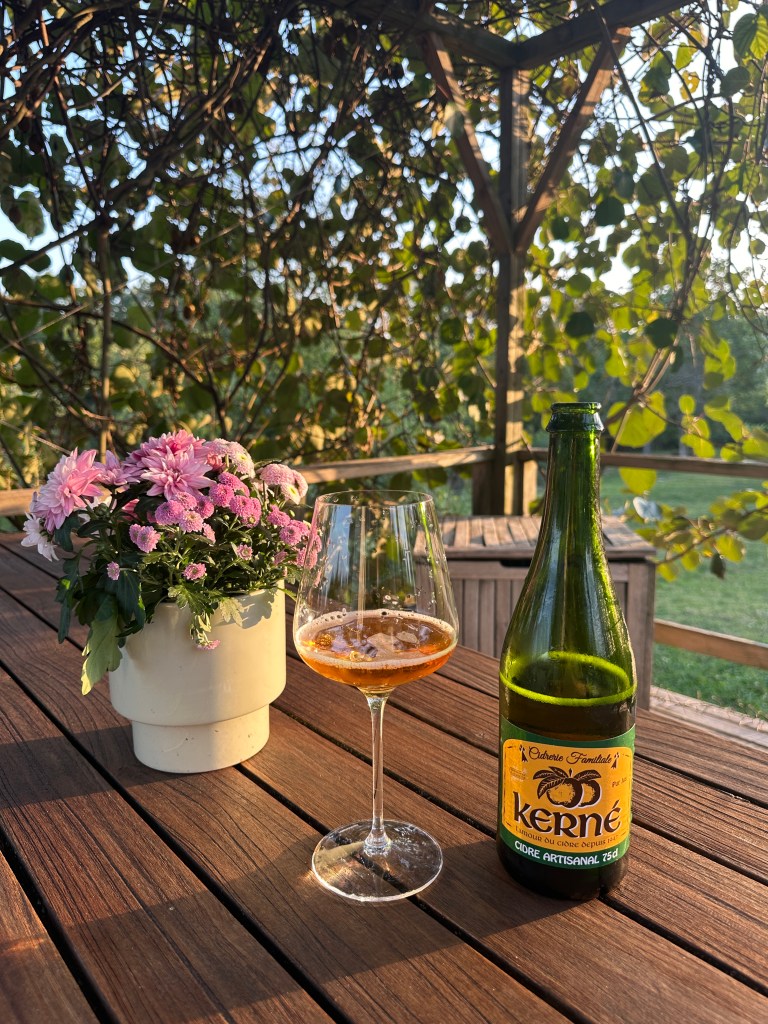
Kerné Cidre Artisanal – review
How I served: 15-20 mins out of the fridge, in a big fancy wineglass.
Appearance: Brilliantly clear amber-gold; a decent head which doesn’t fully dissipate.
On the nose: Very welcoming, like most sweet, tannic, keeved French cider. After a while, a real horse-blanket leatheriness comes to the fore, making the nose more intriguing. There are hints of dusty nutmeg and mace, plus wet wood. Very autumnal.
In the mouth: This is lovely and balanced: not too sweet, with a good mousse (if not a very dense one), and a surprising amount of bitterness. Continuing strong leatheriness, with waxed saddle, vanilla, and overripe apple. After swallowing, a gentle film-like astringency lingers.
In a nutshell: There’s a nice level of sweetness (gastronomically speaking) and lot more complexity than I’d expect of 5.5€ — I would happily buy more of this!
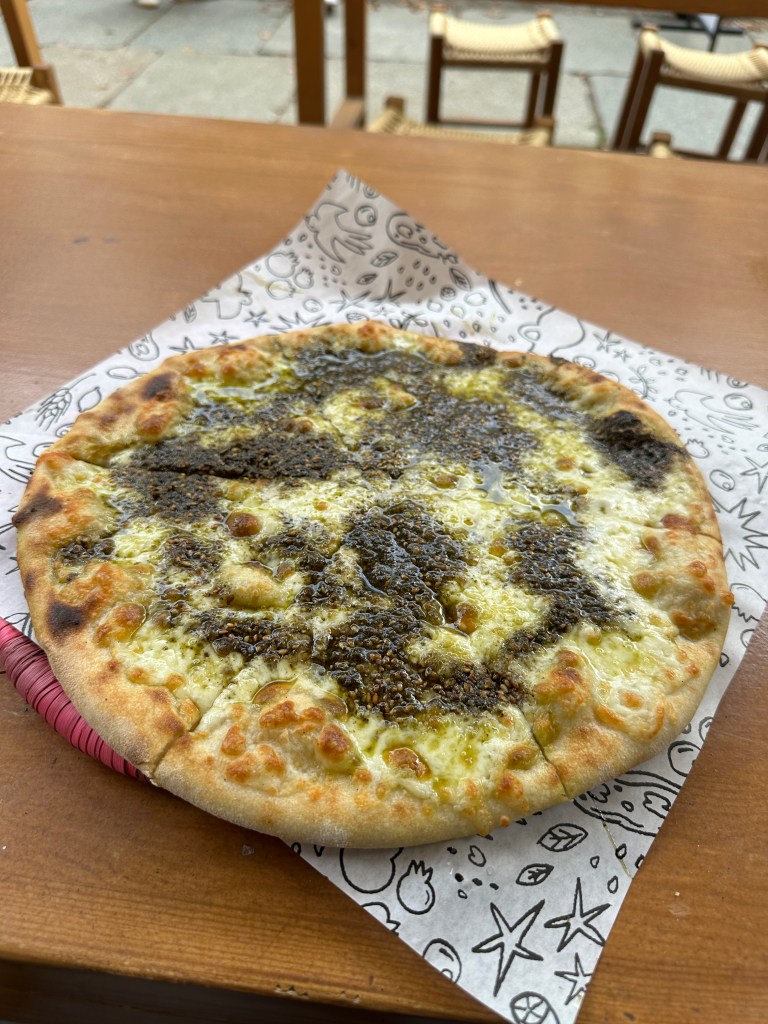
I feel it’s very appropriate that I came away from Berlin having tried ciders from Canada, France, and Sweden as well as Germany. I also had Lebanese, Syrian, and Turkish food while I was there — as well as classic Berlin currywurst and a typical north-German bread roll with smoked eel (don’t knock it till you’ve tried it!).
Sadly, Natalia and I were unable to meet up for a cider while I was in Berlin, as she was visiting her native Poland. That’s another cider scene I’d be keen to explore, especially after the amazing Polish ice cider I tried with Natalia the first time we met!
All in all, I can say Berlin is certainly of interest from a cider perspective. What cider scene it has didn’t overwhelm me, but it was full of interesting nuggets in different neighbourhoods of the city: some targeted more at craft beer lovers, others capitalizing on the (clearly substantial) natural wine scene.
From my few days in Berlin, which invariably give a limited picture, Natalia’s 2017 article on ‘why cider from overseas is easier to get in Berlin than European cider’ now rings true only in part — I was impressed by the range of ciders of European origin I could find in Berlin shops (usually natural wine shops). Sure, there weren’t usually many to choose from on a given shelf, but imagine being able to walk into a London natural wine shop and pick up German, French, Canadian, and Swedish cider! Anyway, don’t get me started on Brexit.
Discover more from Cider Review
Subscribe to get the latest posts sent to your email.
 Cider Review
Apparently not much has changed in Berlin since 2017 in terms of cider; while the rest of the country has experienced a wonderful renaissance of craft makers producing exciting, region-specific cider and perry.
It’s really a shame. Maybe German cider is perceived as less exciting or sophisticated than something from Canada or France. Still, it’s quite an indictment of Berlin bars and bottle shops that they are apparently oblivious of what is happening right next door in the Baltics and Poland; not to mention Netherlands, Belgium and, yes, in Germany.
LikeLiked by 2 people
Thanks Bea, another great article. With a beer list like that, I’d have spent a long time in the Muted Horn!
LikeLiked by 1 person