I can remember the thrill of being offered a taste of Wilding’s cider eau de vie, ‘Orchard Spirit’, by Sam Leach at the afterparty of my first Cider Salon (2022). Not because of the taste of the delicious liquid, although I enjoyed that too. Rather, because it felt like I’d made it ‘in’ to this brave new world of cider — in some tiny way. Of course, Sam didn’t know who I was and was probably just obliging out of politeness.
After a few years in whisky, I have now enjoyed some time focusing on liquids that are something like a fifth to a tenthof the ABV. Nevertheless, the Orchard Spirit has stuck in the back of my mind since the first taste as one of the most interesting fruit distillates I’ve tasted.
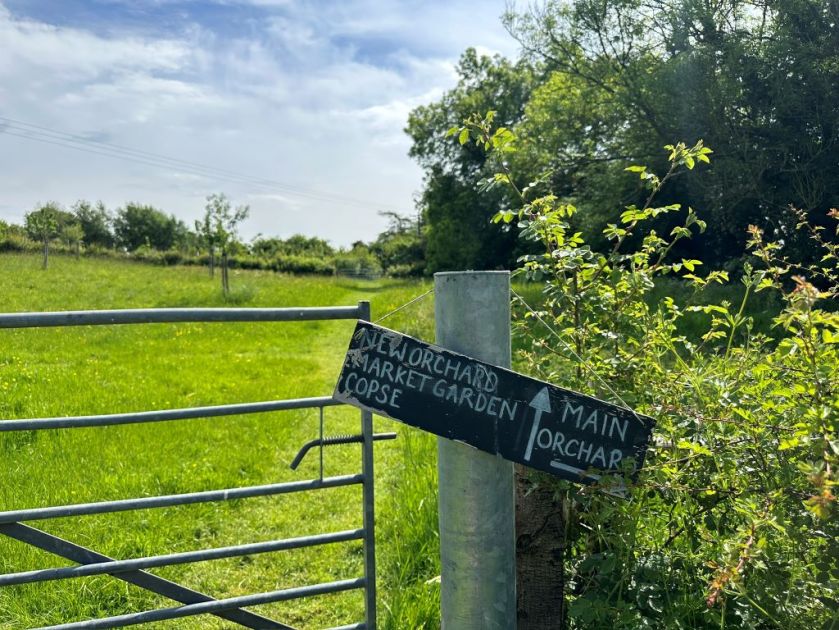
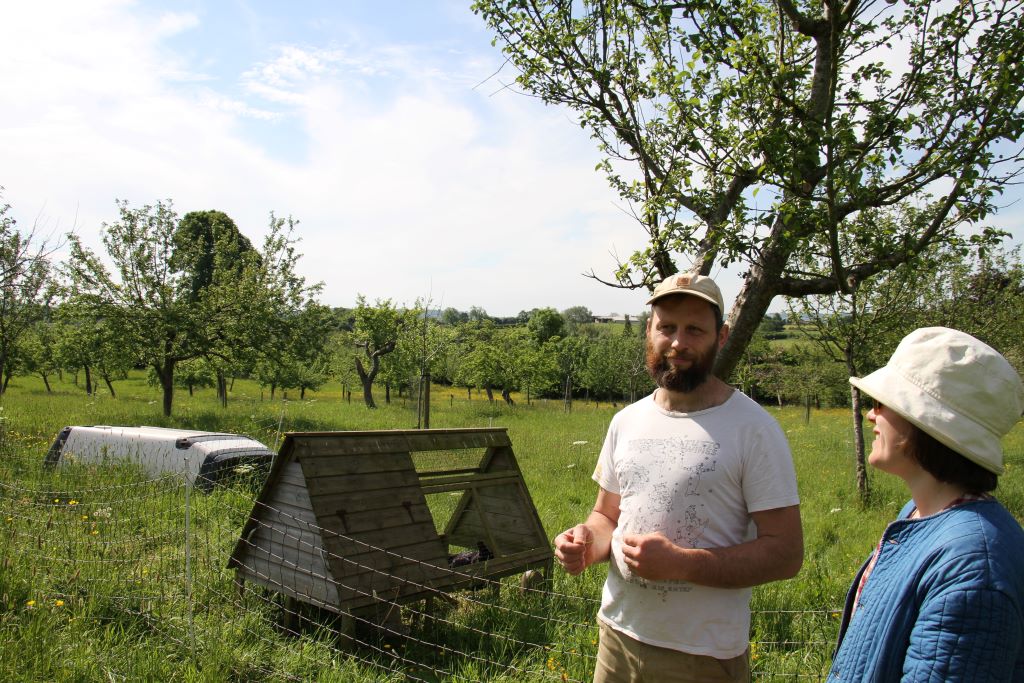
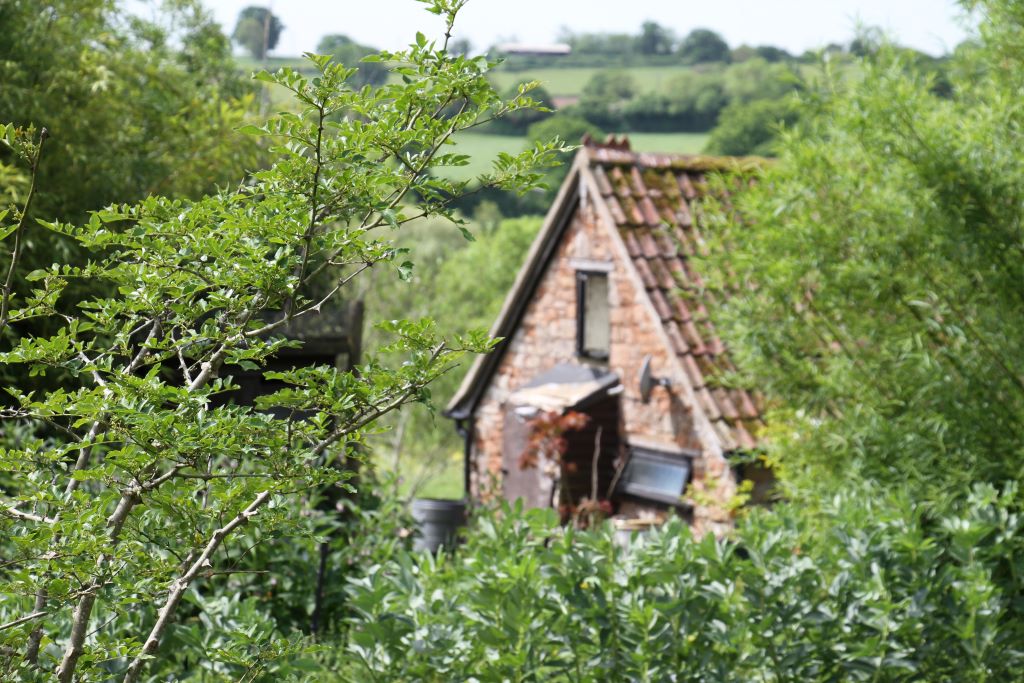
Unsurprisingly, my partner Alfie and I jumped at the chance to visit the Wilding homestead in Chew Magna outside Bristol earlier this year. I actually know Sam now, and, as I suspected, he was most welcoming. While his wife and business partner Beccy was out delivering cider, he gave us a tour of their bucolic sheep-mowed orchards (they manage others’ orchards too), the impressive veg patch and the enchanting forest garden.
After we’d spent some hours outside, chatting about everything from the history of their plot to grafting techniques and Wilding’s focus on biodiversity-oriented orchard management, Sam invited us inside the house. It’s a sensitive conversion-cum-extension of a stone barn that’s still in progress; since moving in in 2019, Sam and Beccy have had plenty on their hands what with two young kids and building their cidery business!
I could wax lyrical about the incredible homemade sourdough we were served alongside butter, honey, marmite and tea — it’s living in my head rent-free, as they say — but instead, I shall share our conversation about Wilding’s distilled products. I learned a lot about the thinking and process behind their distillations, as well as what it’s like to navigate the tax world as a cider maker and grow a small aspirational cider business in the UK these days. Our discussion has been edited for clarity and concision only.
* * *

CR: Were you always planning to distil, or did something inspire you to do it?
SL: We’d always liked the idea of it, but we didn’t have plans to do it at all. Then, just before we were about to sell our restaurant [Birch in Bristol] to start cider making fulltime, the distillery whose gin we’d been buying asked whether we would ever want to do a cider brandy. And we thought, wow, that would be great. Then, in 2018, we’d made this really nice draught cider and I thought, rather than try and flog a draught cider — we’d spoken to various pubs and hadn’t had a very good response — let’s just give it a go! That was the first Orchard Spirit we released.
CR: So, you don’t distil yourselves — that seems to be the way with the small producers. I’m curious about how this ‘contract distilling’ works. What is the process?
SL: There’s a whole spectrum of ways you can approach it. You could go to someone and say, “Please make me a cider brandy and then I’ll put a label on it,” and then you have nothing else to do with it. Alternatively, a lot of people make a cider and then send it to a distillery and let them do everything — it comes back to the cider maker as cider brandy. We want to have a bit more involvement, if possible.
CR: Are your drinks distilled with a pot still or column still?
SL: It’s a hybrid of pot and column which double-distils in one go and uses the heat from the first distillation to do the second. Most modern stills I’ve seen are like that. I know that some people are very nostalgic about the simple pot stills, of course. We haven’t done our cider in a pure pot still, so I can’t really say how it would differ, but from tasting lots of people’s spirits, I think some of the more modern stills give a more elegant, less harsh, less heady spirit.
The quality of the still they’ve got at Circumstance Distillery in Bristol is a real attraction for us to use them. Obviously, the price of any still is a lot, so if you’re only making a small amount, it’s difficult to justify getting your own. And I’m not sure we’d ever be able to justify it, really; certainly not for a long time. Circumstance’s still fits 1,000 litres, so we basically take 1,000 litres at a time and collect the distillates in separate containers [for context, this is tiny]. You can’t really distil cider in the summer, so we’ll do the rest in September.
CR: Why can’t you do it in the summer?
SL: The lactic acid bacteria create a compound in summer which gets redigested when the temperature cools in the autumn. If you distil while it’s present in the summer, you get a sort of mustardy horseradish smell. We discovered this by having a batch like that — I should have done the research first. The smell did go eventually, but it took two years! Now, we don’t distil it in the summer.
At the start of harvest, we taste through everything and make the decision of what’s going to go into pommeau, into eau de vie, and into cider brandy. For the eau de vie, we’re generally looking for a slightly fruitier, sweeter character, ideally with fennel-y, anise-style notes — Major, Ellis Bitter, Tremlett’s Bitter, Brown’s, that kind of thing. For the cider brandy, we’re looking for a mix of those and the characteristic late season pressings, with richer, more complex, less fruity notes. Usually that’s Dabinett, Ashton Brown Jersey, Chisel Jersey, things like that. We try and use as many varieties as possible for lots of complexity, taking a cue from Calvados and Somerset Cider Brandy. We’re also going for about 80% tannic fruit, mostly bittersweets. The bittersharps also work well; we just don’t have very many of them.
CR: I’ve always been struck by how the Orchard Spirit has a real feeling of sweetness, even though I know it’s not possible for an unsweetened distillate to actually have sugar in it. Do you know where that sensation comes from?
SL: I think it’s to do with the texture, which is something to do with the alcohol. I really like that character; I want to know why it’s there and what we can do to keep it and promote it. That’s one of the many things I need to research.
CR: Does the spirit change a lot year on year?
SL: It definitely does, but because you’re stripping acidity and tannin out of the equation, it’s less apparent than in the cider. And you’re concentrating the harvest, so you might get generally similar spirit from one year to the next, but in some years, you’re getting more of it. … And it is 40% alcohol: nuance-wise, you’re always going to be fighting up against the alcohol, whatever the year. In cider, a change from 6% ABV one year to 8% the next year makes a much bigger difference to the perception of everything.
CR: So, are you looking for a particular ABV when you choose a cider for distilling?
SL: I do think higher-ABV ciders tend to make better spirits. I used to think it would surely be better to distil a large volume of low-ABV cider because you’d be concentrating more aroma in the final product, but actually, higher-ABV cider runs more smoothly and quickly through the still. My observation so far is that we tend to get the classiest, most elegant spirit from the higher-ABV stuff.
CR: And the tannins are completely lost, right? Because it feels like you can taste those, too!
SL: Yeah, the tannin is lost, but the phenolics which you would associate with tannic apples do come through. It feels like you can smell tannin, but you’re just smelling other things you often smell when you smell tannin. It’s a really interesting, fun, and fascinating process.
* * *
At this point, I feel like it’s time to pause the interview and taste some!
* * *
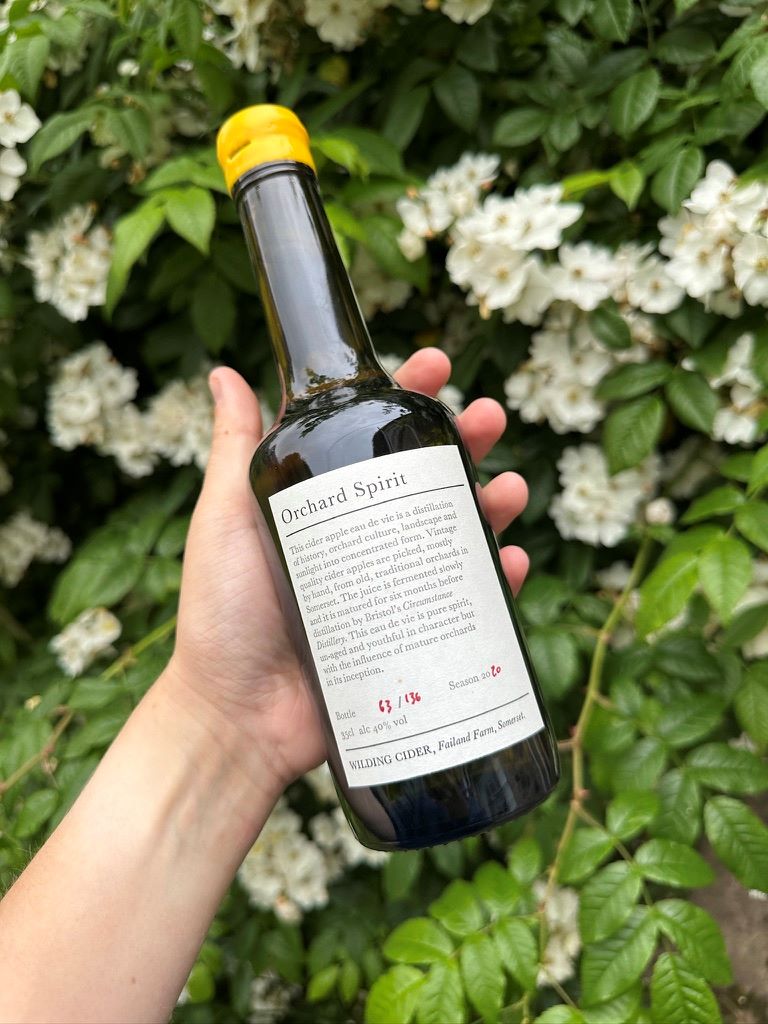
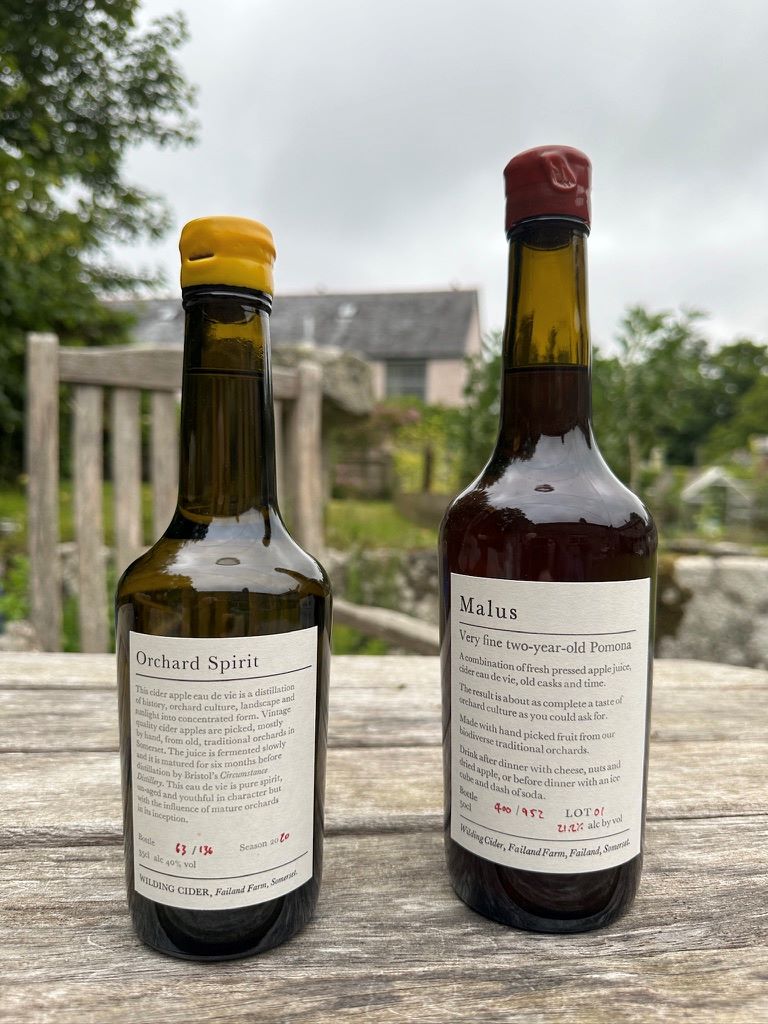
Wilding Cider, Orchard Spirit 2020 – review
How I served: Room temperature.
Appearance: Looks like water with legs. Perhaps it’s just a hair darker than actual water.
On the nose: I’m smelling buttered popcorn and the pale yellow apple sauce that comes with your carvery pork roast. A grain mash note makes me feel like I’m smelling new make whisky, but with the clear sharpness of apple added in. There’s an intriguing rubber/chlorine note. Something savoury I can’t put my finger on lurks in the background.
In the mouth: A papery spirit character on which fleeting pome notes dance. A creamy sweetness contrasts with a relatively drying feel and a lengthy ‘green’ finish. There’s a slightly odd but not unpleasant note of graphite pencil.
In a nutshell: I remember this having more intense flavours and a clearly perceptible tannic sweetness, both of which I don’t get as much here. However, I was probably tasting a different vintage, and variance is to be expected. It’s still a delightful and complex spirit which is more austere and ‘fresh’ than the ripe fruit-forward Malus (see below).
—
From distilling, we steered quite naturally into a discussion of taxes. Where there are stills, the excise man is never far behind…
—
CR: Can you tell me about the size of your distilling operation?
SL: In our second year distilling, we made 5,000 litres; the year after that we did 7,000, and we’ve been in that range ever since. From 2022, it will end up being 8,000, and I think this year, 2024, we’ll aim to make 8,000 or 9,000. It’s quite terrifying in a lot of ways, because the eau de vie is not a high-margin product: it’s very expensive, but the margin is lower than with the bottled cider. There’s more cost associated with it, and you concentrate all the labour — and of course the duty is substantially higher. It’s not like you’re just concentrating cider duty!
CR: Where do you warehouse your casks of spirit?
SL: At the distillery, which is really important. When I talk to other cider makers about what they’re distilling, storage is the difficulty. We’re lucky in that we can just pop over and check on our barrels and their ageing. We do pay rent on the barrel space, obviously, but it’s nothing compared to building a building!
If we had more space where we are now, maybe we would register it [as a bonded warehouse]. And we might still do that: at the moment, we share our making space with Wild West Cider and our winemaking neighbours, but they’re about to start building their own winery. We don’t actually need that much space: all our barrels are on racks, so that’s just two barrels of floor space, going about five barrels high. We would just have to mark an area as the ‘spirit bond area’ and do quite a lot of paperwork.
It’s not quite as bad as it was. When the Temperleys [at Burrow Hill, who make Somerset Cider Brandy] first started, the warehouse had to be completely locked with a padlock that had a wire with a numbered metal tag on it. They were given these tags by HMRC, and every time they cut a tag to go in, they would have to store the tag and keep a record of why they went in and what they were doing. They had to do so much work just to taste something or show someone around! Now, they just have a line on the floor in the warehouse between what’s ‘duty paid’ and ‘duty unpaid’. I suppose tech is a big part of it, because barrel can be logged with the government now: where it is, what ABV it is, and what they’re going to do with it.
CR: We went to see Martin at Pilton when we were driving up, and when we were discussing duty, I was fascinated to hear from him how the government essentially treats a distiller’s — or any alcoholic drink maker’s — stock like its own money. You’re holding their money, and they want to know where their money is and what you’re doing with it. What would happen if you personally decided to drink all your Orchard Spirit, essentially drinking away that potential duty?
SL: If you drink it yourself, it’s duty free — if you’ve grown the fruit. If you buy the fruit or juice in, you owe the government, whatever you do with it. There is an exception for samples, but it’s a bit of a faff, because you have to record everything and then claim it back. We tend to just pay the duty on samples. With other countries paying so much less duty — in America, it’s about a couple of cents a bottle for cider — a lot of cider makers will make a batch, bottle it, and then pay the duty. Then you know it’s done, and you’ve only paid about $50.
It would be much easier not to have to do our monthly duty returns! Because we now get free duty equivalent to the first 7,000 litres, and we’re not making much more than that of cider, we don’t pay duty on most of it. In fact, we’re paying significantly less than we were before. But when you think of someone like Thatcher’s, whose numbers are much bigger — they’ll be paying hundreds of thousands in duty, but they’ll be doing the same amount of work on their returns, and they’ll have someone who’s paid to do them!
CR: Interesting. I don’t know if I ever considered the labour involved in the returns as effectively part of the tax.
SL: To HMRC, who are all ‘numbers people’, this probably seems streamlined and simplified: you just pay per millilitre of alcohol, and beer and made wine and everything are all the same! In reality, you now have potentially thousands of duty bands — every 0.1% of alcohol is a duty band of its own. On top of that, every small maker gets a different level of duty relief depending on how much alcohol they produced the year before. Anyone like us, whose production changes year to year, will have a different duty rate relief every year. And believe it or not, because we make in the same building as other people, our allowance is dependent on their allowance as well, even though one of them is a wine maker who doesn’t get small producers’ relief, and the other is making cider at such a small scale that they don’t pay any duty!
CR: [My built heritage consultant boyfriend noted here that there used to be a levy on bricks. Not the bricks used, but the bricks made! This was the British government’s bright idea to cover the (sunk) costs of the American War of Independence. The taxman would turn up at every brick factory and painstakingly count the number of bricks manufactured, stamping them with the word ‘excise’ so you could tell what bricks had been examined. Under this system, there was no incentive whatever to innovate and create faster, more efficient brick-making technologies — you’d be taxed on any bricks messed up in the process of experimentation! This went on for 100 years until people decided in 1850 that the brick manufacturing industry was being too greatly hampered. Any new government — ahem, ahem — who might want to stimulate native industries, take note.]
SL: I don’t mind progressive taxes, such as on excessive wealth or smoking. But when they applied champagne tax to sparkling cider, it just killed the industry. It went from being something that employed a significant number of people in several factories to something that employed almost nobody. And the 7,000-litre limit? That was instituted to exempt farmers whom it would have been pointless to tax, but it’s meant that all the craft cider makers in this country have been forced below this point — it’s incredibly difficult to grow beyond it.
I think a more realistic amount to make as a craft producer — as a grower-maker with very hands-on processes — is about where we are: somewhere between 15,000 and 30,000 litres. I would be interested to know how many people in the UK currently fit that bracket — very few, maybe three to five. Everyone else has either taken that leap beyond to 70,000 or 100,000 litres, or they’re below 7,000. It’s insane to have a business where you need to double or quadruple to be able to grow.

CR: How long did you guys take to go beyond the duty threshold? What was the catalyst?
SL: We went very quickly. We did one year below 7,000 litres, and the next year we went above. We knew we couldn’t make a living below 7,000, at least not for both of us, and we didn’t want to have a situation where one of us had a full-time job and the other was trying to run this business. Also, we wanted to have kids and both have that flexibility to be at home; otherwise, childcare is incredibly expensive. I could have got a well-paid job in hospitality, but there you have to give everything, 80 hours a week, and I would have hated that. So, it was kind of bloody-mindedness, I suppose, deciding that we just had to take the pain of effectively competing with people who don’t pay duty…while paying duty.
CR: Do you think it was a smart move, though, to push through that wall early on?
SL: I suppose we thought, if nothing changes with tax, we’ll still have to do this sooner or later — so we might as well get on with it. And we thought that it might change, meaning our life would get a bit easier later down the line, at least in a narrow financial sense. So, we took the plunge — in a slightly pig-headedly way, I suppose. Also, if you want to make spirit, you’ve got to be above 7,000 litres, otherwise it’s just such a huge chunk of your production to make a very low margin on.
The long-term goal — but for this, we need our own space — would be to make around 20,000 bottles of cider and perry a year, and then 5,000-10,000 litres distilled. Right now, the market for the bottles isn’t buoyant enough to justify that. That said, things have dramatically improved since we first started. Tom Oliver is one of those people who’s always been making fine cider, but his business has changed a lot as the demand for the large bottles came about: he dramatically dropped the amount of bag-in-box he was doing and moved across into the bigger format. I’m very optimistic about it all, but change is inevitably very slow; that’s the nature of cidermaking.
CR: It only happens once a year!
SL: Yep, and then it can take 18 months to be sellable! You’re always like trying to guess what you’re going to be doing in two years’ time, and that’s kind of hard. I guess we were lucky to have export interest quite early on, so we responded to that and made lots more cider. Of course, it’s been so slow to get export actually happening.
Brexit is the key problem here: it adds a year to the timeline. We’re now exporting to Japan and Belgium, with Japan being the easier one — even though they still work at very long time scales and have to bring over a full container of UK cider from all sorts of producers at one time. For example, our Belgian importer, El Cider, also imports Oliver’s. Pre-Brexit, it cost £150 for them to import a pallet from Oliver’s, while from a pallet from Normandy was about £120 — not too different. But now, after Brexit, it’s £600 for that British pallet — £1 a bottle for something they might be paying £5 a bottle for! El Cider actually set up shop because they fell in love with English cider — that was their whole plan — but Brexit ground everything to a halt, and they got going with all these amazing Normandy producers instead. Normandy is now the bulk of what they sell, and that could have been the UK!
CR: I think, if not for Brexit, there would be a massive market for all the UK’s fine cider in Europe. What with the history of cider regions there and then rise in popularity of drinks like natural wine, there’s an obvious audience for this kind of product.
SL: Definitely. There’s a big thing in France with younger people wanting to drink less. So now, people are looking for lower-alcohol wine, but it’s becoming harder to make that because of climate change. Cider is an obvious alternative. We’ve got that interest in France, but the slowness of the logistics stops people. You can go to any Spanish, French, or Scandinavian cider maker, anyone in the single market, so much more easily now.
I do think the demand for our cider is there and that export is going to become increasingly important. It also helps our home sales: if you say we just sent some to Japan, English people are suddenly much more interested. There isn’t that confidence in our native products here. People go on holiday and rave about the amazing cheese, and then they come back here and just go to Tesco! There’s amazing cheese here too — and the more you buy it, the more there will be.
Of course, a lot of European countries actively subsidise quality, while in this country, we often actively subsidise low quality by giving the quality producers zero support. There are lots of things the government could quite easily do. How about a different tax regime for quality, full-juice cider?
CR: Amen to that.
* * *
Be the tax regimes as they may, Wilding are going to the trouble of concentrating their carefully tended and gathered apples into higher-cost distilled products. And they don’t just make cider distillate, as they also added a pommeau-inspired mistelle to their range in time for Christmas last year (read Adam’s exploration into apple and pear mistelles here).
French pommeau is bittersweet apple juice fortified with cider brandy and aged (read more in Adam’s ‘Spotlight on Pommeau’). However, as Pommeau de Normandie is an EU-protected term, these types of drinks are usually referred to internationally as mistelles, following the cue of wine-based drinks made in a similar way. Wilding have titled their mistelle ‘Malus’. As a lapsed (medieval) Latinist, I love the name: of course, it’s our favourite genus, but malus is also a mysterious word that can mean many things including ‘apple tree’, ‘evil’, ‘wine-press beam’ and ‘ship’s mast’.
It’s only recently that the UK’s small-scale aspirational cider makers have forayed into this genre. Sam told me: “I feel like pommeau is such a nice drink. Everything I’ve said about distilling the orchard into spirit holds true for the pommeau, but the product is much more sippable and more suited to the English palate that loves sherry, Port and Madeira. I think we’re going to see more of it.” As you’ll be able to tell from the review below, I certainly hope so!
Excitingly, the Malus and the Orchard Spirit will soon be joined by more Wilding distillations: Sam and Beccy have recently bottled their first pear spirit, and later this year, they are going to be releasing a rye whisky cask-aged ‘poireau’ (a mistelle made from pear spirit and perry pear juice, in this case Barland). An aged cider brandy is also in the works: “I hope that the eau de vie and pommeau will have opened up the market a bit for us, and that the same people will then be interested in the brandy,” says Sam. “When I’ve done back-of-the-envelope calculations of how much [the brandy] will need to be sold for, I’m a bit daunted. But then, you look at what whisky sells for…” Hopefully, more consumers will soon come to appreciate the Preisleistungsverhältnis (‘price-value relationship’, perhaps my favourite German word) of distilled products like Wilding’s.
* * *

Wilding Cider, Malus (Lot 01) – review
How I served: At Cornwall’s ever-chilly room temperature. (Should I be chilling it? Thoughts on a postcard from Normandy, please.)
Appearance: Dusky, hazy amber-to-chestnut — almost brown.
On the nose: This smells like Calvados with the edges smoothed. Alongside the obvious apple, honeysuckle meets cinnamon and dust. Quite a lot of rubber and chlorine — more than in the Orchard Spirit, but not in a bad way — such that it almost reminds me of a peated whisky (there must be some good phenolics on those apples!). Pretty complex.
In the mouth: Very well-balanced sweetness; it’s not cloying at all. Big clove and caramel notes; sweet, concentrated apple; and more dustiness. Quite a light body — this slips down very easily. Not much finish.
In a nutshell: The sweetness is pitched exactly right, but I was hoping for more body. That said, you could consider this drink delightfully delicate for something of its autumnal, spiced, phenolic flavour profile.
* * *
Distillation is a magical process: a fermented liquid must be heated to just the right temperature to evaporate the alcohol (which has a lower boiling point than water); this alcohol is then recondensed and collected elsewhere in contraptions shaped just for this purpose. Thus, the flavours of the liquid are concentrated, often multiple times, to increase alcohol content and purity. The process is practically alchemical, and it still happens in a version of the historical alembic still, a shape particularly suited to the process and invented close to 2,000 years ago in Ancient Egypt.
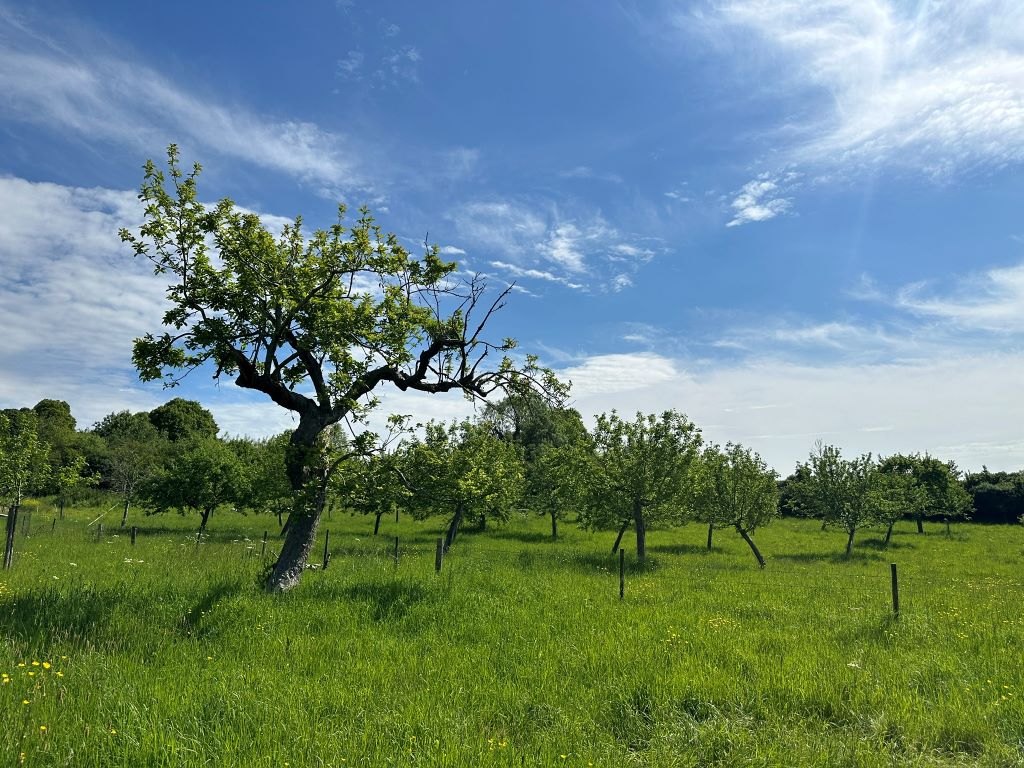
When you’re in the orchard at Wilding, you feel a different kind of magic, a magic which seems to spring directly and effortlessly from the earth. Orchards aren’t really natural, at least not initially or independently, but they feel most comfortingly so. It’s nature in perfectly distilled fashion. You run your hands compulsively over the tantalising diversity of grasses and wildflowers coming almost up to waist height, you listen to the gentle cacophony of birds chattering and sheep bleating, and your weary eyes adjust to myriad shades of green. I never wanted to leave the orchard, but at least I could take its essence home with me.
Discover more from Cider Review
Subscribe to get the latest posts sent to your email.
 Cider Review
Pingback: Some thoughts on natural cider and perry – plus seven from Wilding | Cider Review
Pingback: Pigs, Pomona & Provenance: – Fine Cider & New British Charcuterie | Cider Review