
So far we’ve travelled to North Norfolk (Whin Hill), and South Norfolk (Crones) on the Cider Review Compass of Extraordinary Adventure and Intrigue. Today’s article takes us to the very western fringes of the county, to the borders of Cambridgeshire (but still just inside Norfolk) and the village of Marshland St James. This place is like a few other villages I know in the area, relatively small population (just over 1000 residents) but somehow covering an area of nearly 10 square miles. It sprawls through the fenland fields and dykes, all at or below sea-level, but thanks to some ingenious Dutch-drainage, very fertile land for arable purposes. On the Smeeth Road, the main road which dissects the village, there’s a former train station, now converted into a home, which hints at the old railway line which ran from Wisbech, up to the Kings Lynn mainline, taking Apples, Plums, Pears, and more down to London. This Wisbech Line ran from 1848 to 1968 (courtesy of Dr Beeching), the closure of which precipitated the grubbing up of large swathes of the orchards in the region, a change in farming practices that was further exacerbated by the relocation of Gaymers Cider to the West Country in the mid-1990’s. I like to imagine what the region was like back then, with acres of orchards and the ability to travel to even more towns and villages from the comfort of a railway carriage.
Well, it’s 2023 now, time to take of those halcyon sunglasses. I very much had to use the car to get out here, and whilst most of those orchards were grubbed up to become barley or wheat fields, pumpkin patches, and horse paddocks, a few still remain. This is where I find myself heading, to meet a man who is absolutely passionate about revitalising the veteran trees in his care, planting new ones for generations to come, and making a delicious drink to show for all his hard work.
CR: We’re here in the Fenland village of Marshland St James, having a walk around the orchard of Mr Oliver Mann of Marshland Cider. Please introduce yourself and your cider company Oliver.
Oliver: Hello there! Well let’s see, I’ve always been a cider fan. When we moved here, I spent years renovating the orchard, it’s a very old orchard. It had been neglected for many years. I cleared under all the trees, pruned them, and brought them back into a situation where I could harvest their apples and start making cider with them. I made cider for my own purposes, it was very nice, and people liked it and said, “Oliver you should sell this!” So, eventually I did.
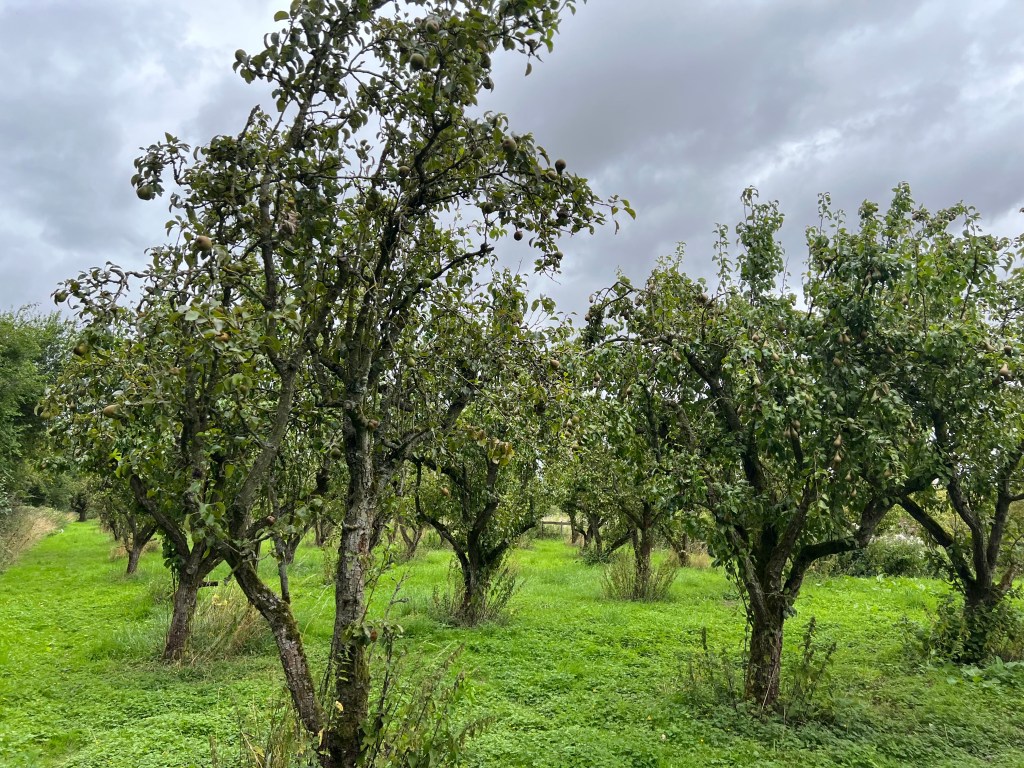
CR: Seems like a good route to professional cidermaking! Tells us a bit about the history of your orchard – is it a survivor of one of those old Fenland orchards that was around in the 1930’s and 1940’s.
Oliver: It’s slightly older than that, planted around 1910, in slightly different tranches. At the time, a lot of Bramley orchards were being planted around here.
CR: What was the Bramley apple used for back then?
Oliver: Apple pies, various apple-related desserts.
CR: Is that what attracted you to this property and its orchard?
Oliver: It’s 11 acres here, I fell in love with the orchard, it was definitely a big part of why we moved here.
CR: It seems quite unique for a cidermaker in this region to move to the area and find themselves with a very established orchard already in-situ. A lot of folk starting up now have to plant their trees and wait around 7 years for them to fruit. This here is quite something.
Oliver: It took a good 5 years to gain access to all the parts of the orchard as it was so overgrown. It wasn’t ready-made in that sense, but absolutely, it’s a massive advantage to have trees already in place. I did loose a number of trees in the orchard – they’d either split or been damaged by deer and rabbits. So it’s a bit gappy in parts. I’ve got a rolling programme of replacing those trees with a mixture of Bramley – to keep the nature of the orchard – and also some cider apple varieties, and other interesting local varieties that I’ve been able to procure.

CR: Along this first row, what is the variety?
Oliver: These along here are mostly Discovery and a couple of Crispin too. But I haven’t really got enough Discovery to make in the quantities I’d like. They fall a fair bit earlier than the Bramley too. I start my cidermaking in October. As we walk into this section of the orchard, you’ll see we’ve got pear trees too. When these pears are ready, that’s when I do my first batch of apple and pear cider.
CR: Do these pears ripen first?
Oliver: Yes. Though the Bramley ripen slowly and in stages. I use windfall apples – using the riper apples to reduce the acidity.
CR: Working predominantly with Bramley and a bit of pear, you strike me as a good authority on the Eastern Counties style of acid-driven cider. What characteristics do you like specifically about the Bramley for cidermaking?
Oliver: I love Bramley apple cider. It has this clean and crisp nature that’s quite minerally. You get a strong apple flavour coming through post-fermentation, which isn’t the case with all ciders. It is sharp, which means it pairs well with food. You get very used to drinking that kind of cider. Although Bramley is the dominant apple I use, I will blend in other varieties, to stop the blend becoming overly acidic.
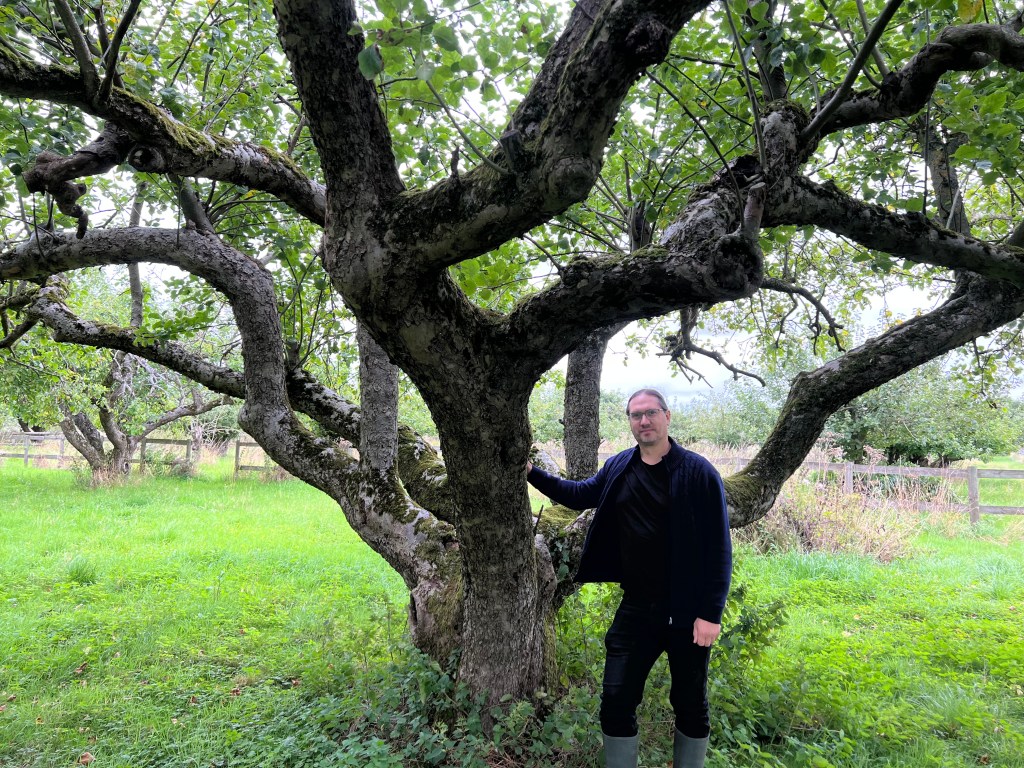
CR: On the pear trees that are surrounding us now, what varieties are they?
Oliver: Mostly Conference, a few Commice, a single Blakeney Red perry pear tree, and I planted another 8 different perry pear varieties last winter. In years to come I hope to include those in the blends.
CR: Looking at the composition of your pyder, do you find that acidity from the Bramley works well alongside the dessert pear juice?
Oliver: It works really well – acidic enough to make a reliable cider (pyder), and people who like perry often say to me that my apple and pear cider tastes quite similar to a perry as it has a similar level of acidity to that which you’d associate with perry pears.
CR: It’s exactly the same idea that Crones here in Norfolk, and Basque Country producer Bizio do. They use Conference and Concorde, and then add in some sharp apple varieties. Obviously, a winning formula. Let’s head towards a Bramley tree, and one from 1910.
Oliver: You’ll notice this one immediately. It’s a huge, grand old tree. With a trunk you can barely put your arm around.
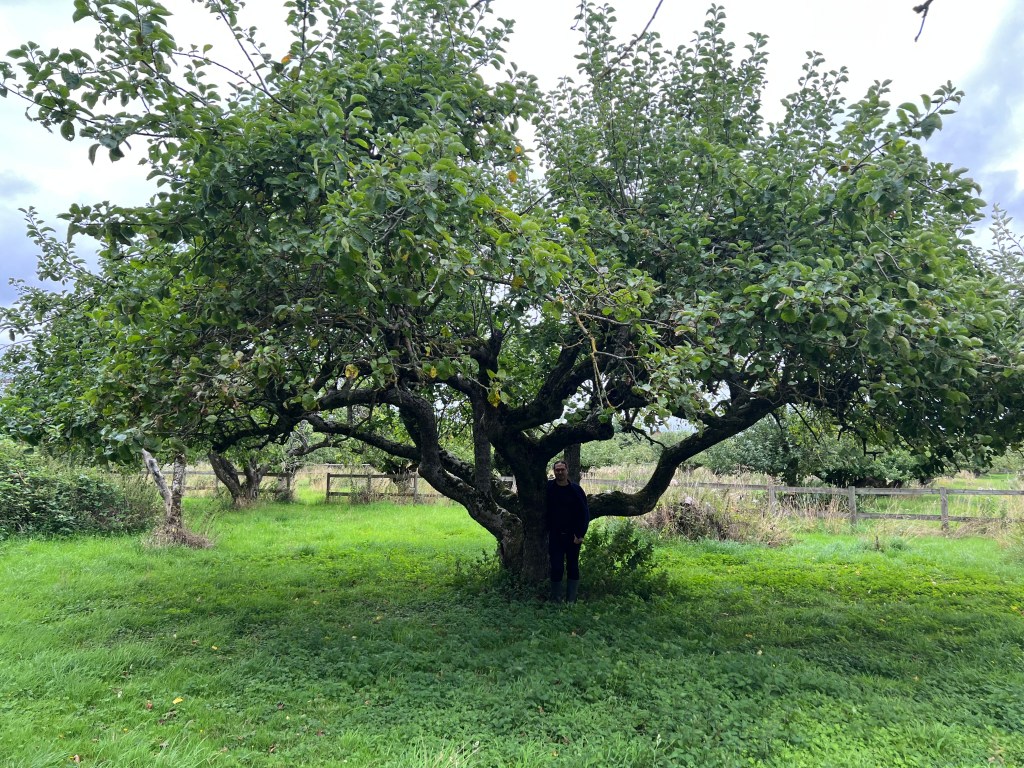
CR: All these trees out here in the middle of the Fens must have good strong tap roots. I see you’ve also got a good boundary surrounding the orchard of mixed hedging and plum trees to mitigate the effect of that Fen-blow (strong winds) we get around here. How are the younger trees you’ve planted here recently taking to this ground?
Oliver: They grow very slowly. The soil is rich though and very well-suited to apple trees. If you go deep enough, it never fully dries out as we are at or below sea-level here. That make them quite resilient to drought once the trees establish themselves.
CR: Useful for years like 2022 where we hit 40 degrees Celsius out here.
Oliver: Absolutely. Standing under this old Bramley tree now, it’s pruned in a unique Fenland-style. Pruned to have a wide spread of branches, quite low to the ground, so easy to pick from and more wind resistant. That style of pruning does make them susceptible to breaking when they’re older though as there’s a lot of weight on these big branches.
CR: Quite a contrast to bush orchards! What was the harvest from these trees like last year?
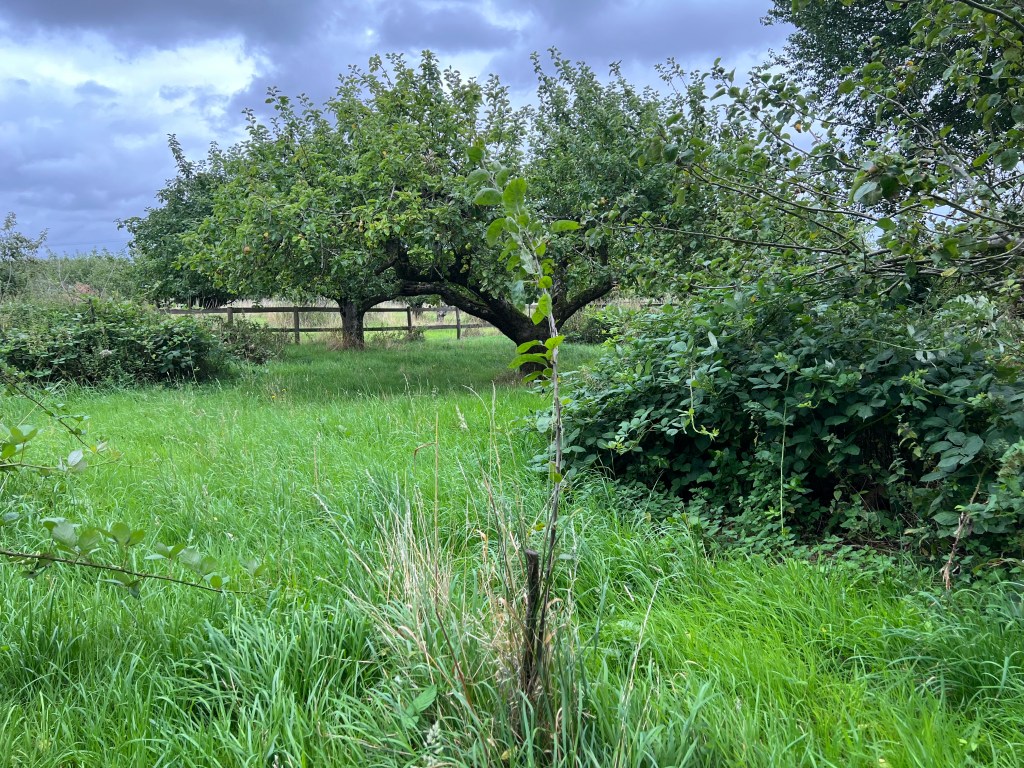
Oliver: It was a marvellous harvest last year – very hot and sunny. The pollination was also really good. The trees were absolutely heaving with fruit. I lost branches from some of the old trees as the weight of fruit on them was incredible. I think we ended up with lots and lots of slightly smaller apples which were noticeably sweeter than usual. Those apples gave a more concentrated juice and so this year, the cider we’ve made from that juice has been stronger and more flavoursome.
CR: Have you kept it at a higher abv to reflect that?
Oliver: I don’t add any water or any sugar to the cider. I think that’s part of being a craft cidermaker, letting the apples speak for themselves. I think it’s the right direction for cider to be made that way. With as low intervention as possible.
CR: What’s your harvesting process out here?
Oliver: I’ve got a 50-year-old tractor. I bring out wooden bushel boxes, place them around the orchard. I then fill them up on my hands and knees and then load on to the back of a trailer and bring them in with the tractor.
CR: Are you hitting the 7000 litre per year mark to come in just under the duty threshold?
Oliver: Last year yes, for the first time. But I won’t have enough apples to do that this year.
CR: Can you comfortably sell that quantity of cider on your scale every year?
Oliver: Oh yes. I’m selling all the cider I make, and it’s been really popular.

CR: What’s your route to market around these parts?
Oliver: The majority of my sales go through markets, a small number of farm shops, and a number of private customers who love the cider and will order a case or two a month.
CR: That’s great to hear you’ve built up a network of fans in this region for your cider, something unique to the area. Not like anything you’ll find in the supermarket.
Oliver: I think it’s great for people to have the opportunity to buy a local product, that reflects their local area. Everyone around here will know that Bramley has a strong history in this region. I was brought up in a village, so I totally understand the appeal of a community spirit based on produce that is made locally. In front of us here is a sapling tree, around 4 years old. I grafted this myself a few years back. I bought 100 rootstocks one year and 100 the next year, grafting a range of things. This is what I want to repopulate and restock the gaps in the orchard. It would grow a lot faster I’m sure if I looked after it a bit better.
CR: There’s something to be said though for letting these trees grow a bit more like wild apples, stressing them a bit so they send their tap roots down nice and deep. We’ve been walking now for 5 to 10 minutes through the orchard and we’re still not at the back boundary. This is a big space.
Oliver: This area here, unfortunately all the trees bar the few that are left, they all died by ringbarking. They were old trees, very overgrown, nearing the end of their natural life. So, what I’ve done back here is clear them and replanting around them.

CR: Where do you see yourself fitting in in this region in terms of the history of cidermakers in East Anglia? There obviously was a lot more activity here up to the mid-90’s when Gaymers was still based in this area.
Oliver: Certainly, in no time in the near future do I intend to grow and become a big cidermaker like Gaymers was. I would see myself stabilising the business at 7000 litres a year. Streamline a few more things so I have time to tackle the other projects I haven’t gotten around to yet.
CR: Is that 7000 litres a year output sustainable for business of your size?
Oliver: It’s phenomenally hard work for a new business. Unless you’ve spent a lot of money in equipment, then it’s always going to be very hard work.
CR: Is all your cider wild ferment?
Oliver: Yes all wild fermented.
CR: Let’s talk presentation, I’ve had 500ml bottles from you. Do you do BIB?
Oliver: I don’t currently, I might consider it in the future.
CR: It would be great to see your drinks at Cambridge Beer Festival, Norwich Beer Festival and the like.
Oliver: The problem is the cost price per litre for a BIB is a lot less than for a bottle. I’m limited by how much I can make, and as I can sell everything in 500ml bottles at the moment, it makes sense to stick with them.
CR: Would you be interested in going to a 750ml or Magnum size?
Oliver: I might consider it, but the process of bottling that I built myself, is built around 500ml bottles. So, I’d have to make some big adjustments or build a new bit of kit. As we walk over this way, this is a new piece of the orchard. Historically it was a plum orchard, but when I moved here there was only 1 plum tree that was left. These trees are all cider apple trees. They were kindly donated to me in connection with the East of England Orchard Project. These were grafted by volunteers and donated to worthy causes around the region. I was flattered to be included in that. 27 trees and around 9 different varieties including Michelin/Bisquet, Dabinett, Yarlington Mill, Browns, Tremletts Bitter.
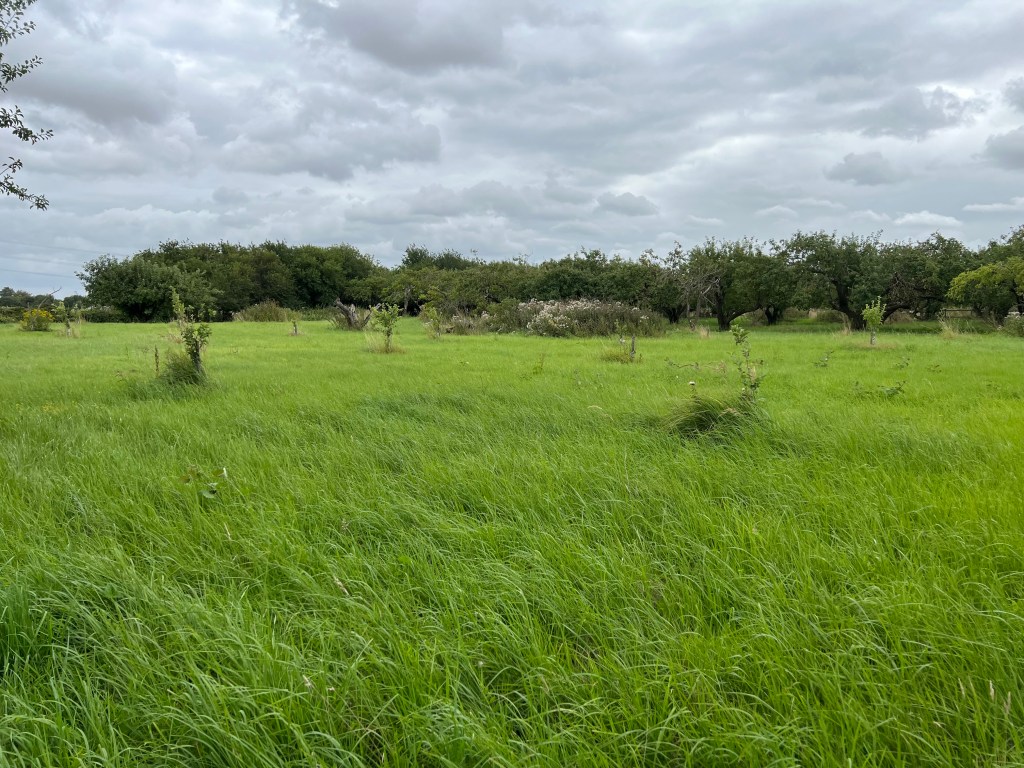
CR: Ah you’ve got the greatest hits of cider apple varieties going on here then.
Oliver: They’re around 5 years-old now, so in a couple more years we should see fruit appearing on them. As you can see, they’re not very big, my low intervention approach to orchard management means they haven’t been mulched or weeded around the base. They’re left to fend for themselves.
CR: Will you then blend in cider apples with your Bramley?
Oliver: I’ll want to keep the nature of my more popular brands of cider going for the moment. I’ll probably experiment with different blends. I make 7 different batches of cider each year, so the apples that I harvest for each batch will inevitably end up being a slightly different batch of apples depending on what’s available in the orchard. I harvest the Bramley apples from October to as late as December, so they should tie-in nicely with cider apple ripening times.
CR: Is the SG super high on those Bramleys in December?
Oliver: I thought it might be, but it wasn’t. I wonder if it was because they’d been on the ground for longer and they’d used up some of the sugar in that time. A large part of why I make cider is because I love these trees and this orchard. If I can make a living out of selling the products of the orchard, then I can carry on looking after it.
CR: Looking at some of these deceased Bramley trees here in this part of the orchard, do you like keeping them here in-situ?
Oliver: It’s good for the insects and the overall biodiversity of the orchard if you can leave standing deadwood. I’ve kept piles of logs around to naturally decay for the same reason. This Spring however it was cold, wet and we had that really strong North-Easterly wind for ages so there weren’t as many pollinators around and now we don’t have as many apples on the trees as in a good year like 2022. I’m hoping some people will donate some apples from around the neighbourhood to help tide me over this year. It would be quite helpful this year. These trees in the orchard were pruned and established in a certain way when they were younger, but I am now putting my own stamp on the trees with my pruning style as I ideally need to get my mower underneath them.
CR: It’s quite something to have an orchard that spans two centuries and is still producing apples that are being enjoyed by people in the region. Thank you for showing us around.
Discover more from Cider Review
Subscribe to get the latest posts sent to your email.
 Cider Review
Pingback: Charnwood Cider: An Orchard in a Forest | Cider Review