In 1986, Carlo Petrini founded a movement. Slow Food. If it sounds like the opposite to fast food, you’d be right. At its core is the belief that food is not only a basic right, but we also all have the right to food that is good, clean, and above all fair to everyone involved in the chain, from grower, processor, maker, supplier right through to consumer.
In the context of Slow Food, good, clean and fair means food that is enjoyable, nutritious and rooted in local character, produced in ways that respect the environment, biodiversity and animal welfare, and created through a system that treats workers and producers with dignity, pays them fairly while keeping quality food accessible to consumers.
When you think about it, we’ve moved pretty far from that in the global economy, and having spent three days in September at the Terra Madre Salone del Gusto in Turin, surrounded by coffee and cocoa farmers, hearing about the challenges they face, and the stories behind the very origins of the coffee and chocolate we enjoy, it shames me to think that most of us can’t put a face, let alone a name, to the person whose labour made it possible in the first place. And that’s just a small part of what Slow Food represents.
Slow Food is also political. As they put it, politics is the big lever that can enable change. As with any labour-based movement, small farmers and makers are stronger together, locally and regionally, but also, through an organisation like Slow Food, globally.
The way Slow Food is organised can sometimes sound a bit alchemical to uninitiated, involving Convivia, Presidia, Alliances, Coalitions and the like, but it is slowly making sense to me. I won’t explain every one of these but, as a primer, the Slow Food International mothership is headquartered in Bra, Italy. Many countries have their own chapters – Slow Food USA, UK, Germany, Austria, Colombia, Kenya, Philippines… (it’s a long list). Each of these countries or chapters is made up of many Convivia, a Convivium representing a group of like-minded people in a region, pulling together to support the principles of Slow Food. They will come from a broad background, including farmers, makers, bakers, eaters, drinkers – people that join as members or supporters for a fee that goes to support both the local chapter and the international foundation.
A Slow Food Presidium is a grouping that brings small-scale producers together to protect a traditional food, crop, animal breed or production method at risk of disappearing, so very much focussed on a single theme. Did you know there is a Slow Food presidium for perry in the Three Counties? I didn’t.
And finally, there are Coalitions. These cast the net much wider geographically, bringing producers, experts and supporters together around a particular food, drink or issue. Guided by a shared manifesto, they exchange knowledge, promote responsible production and aim to give their members a stronger collective voice.
Ok, so far so good. But what has all of this got to do with cider and perry?
In September this year, Slow Food launched a Cider Coalition, something that I believe is rather significant for the world of cider.
How did we get here?
The idea of a Slow Food cider initiative began in 2019, when Darlene Hayes (cider writer, educator, researcher) was invited by Ian McFaul to draft a manifesto modelled on the wider Slow Food movement. Her initial contribution was essentially a position paper, setting out why traditional and small-scale cidermakers needed greater recognition and support. It received an encouraging response from Slow Food International, but progress stalled during the Covid pandemic, as did many things.
The project resurfaced in 2022 through an article for Malus, intended to find others willing to help develop the idea. Although it didn’t immediately attract a wider working group, Darlene had been invited to contribute to the Slow Wine USA Guide and, wondering if something similar might be possible for cider, accepted. This led to contact with Danny Childs, who had been working with Slow Food for some years already, and was assembling a broader Slow Beverages network to encompass cider, wine, beer and spirits. He had reasoned that while each of those categories faced its own distinct challenges, they had enough commonality that a mutual support network would be of benefit..
From 2024, regular meetings brought together people interested in different drinks traditions, and the idea for a network was presented at Terra Madre 2024. Hayes recruited Brandon Buza (professional photographer, advocate for all things fermented), with Michelle McGrath (former CEO of the American Cider Association) later joining the effort.
While a manifesto was under consideration, the group was also finding ways to put cider in front of the wider Slow Food community. At Terra Madre Americas in Sacramento in September 2025, donated ciders featured at the wine bar, and a sold-out cider masterclass with cheese pairings drew an enthusiastic audience.
A meeting with Maddalena Schiavone and Emanuele Dughera brought together supporters of different drinks traditions from around the world, and by December, they came back with a proposal: rather than a regional Slow Beverages network, Slow Food wanted a global cider coalition.
Slow Food International thought cider should have a place at the Slow Wine Fair in Bologna, early in 2026. This was realised through exhibitors (Ross Cider was there) and masterclasses on cider and perry. Alongside the tastings, there was a chance to sit down and discuss exactly how such a coalition might practically work.
At this point, the group had already been working on a proposal for a Slow Cider Manifesto. Hayes had prepared the first draft using the Slow Wine manifesto as a reference, and the team circulated it among cidermakers, writers and advocates across several countries. The returned comments brought practical knowledge from different regions and parts of the cider chain, and the document was revised collaboratively before finally being submitted to Slow Food International, which accepted it.
The door was now wide open for a global Cider Coalition under the auspices of Slow Food International, and that meant some structures also needed to be put into place, including an advisory board/steering committee.
The Slow Food Cider advisory board began with an invitation to those who had reviewed and commented on the manifesto (for full disclosure, I am honoured to say this includes myself). The aim was to bring together people from different countries and aspects of the cider community who could look beyond their own businesses and consider what cider and perry need more broadly. Its purpose is to identify how to best support producers working within the manifesto’s principles, and how Slow Food can help through practical tools and stronger regional networks. But this is a starting point, not a structure set in stone: the board is a work in progress, a living group whose membership and approach will evolve as people join, step back and bring new perspectives.
So, after several years of writing, consultation, meetings, events and relationship-building, the Slow Food Cider Coalition was finally launched in September 2026, a cooperative effort that intends to connect cider advocates internationally, and with a shared organisation.
It’s been a journey! That’s probably a lot more detail that you ever need on how we got to this point, but I know people will wonder where this all came from, and that initial group put a lot of work into it. So now you know.
So, looking back at the main aim of Slow Food to make food available that is good, clean and fair, what does all of this mean, and how does this relate to cider?
In short, good simply means producing authentic cider and perry that reflect true regional character, apple and pear diversity, and traditional knowledge without artificial shortcuts. Clean means using sustainable orchard management, local fruit sourcing, and methods that protect biodiversity and respect the land. And fair means supporting small-scale producers, fair labour and prices for all, and strengthening the connections between communities and rural heritage. Simple, eh?
The manifesto
As already mentioned, Slow Food coalitions are defined by specific manifestos, and cider is no different. The Slow Food Cider manifesto is a guide on what counts as a slow cider or perry. It may well be that some makers have a range of products, some of which may be counted as slow, and others not, or even some in a grey zone. But let’s step through it, starting with the introduction.
“The Slow Food Cider Coalition was created to bring together and champion cider and perry producers whose work is grounded in the principles of Slow Food: good, clean and fair. Cider and perry are agricultural and cultural products: they are born of fruit, land, seasons and the choices made by those who grow, harvest and transform, while safeguarding knowledge and skills. They are not industrial commodities, disconnected from their origins and standardised for the market. They can bring value to overlooked varieties, support farming communities in marginal landscapes and protect the places from which they come. For this reason, cider and perry made according to Slow Food values must be recognised for what they are: the authentic expression of a place, a community and a responsible way of producing.”
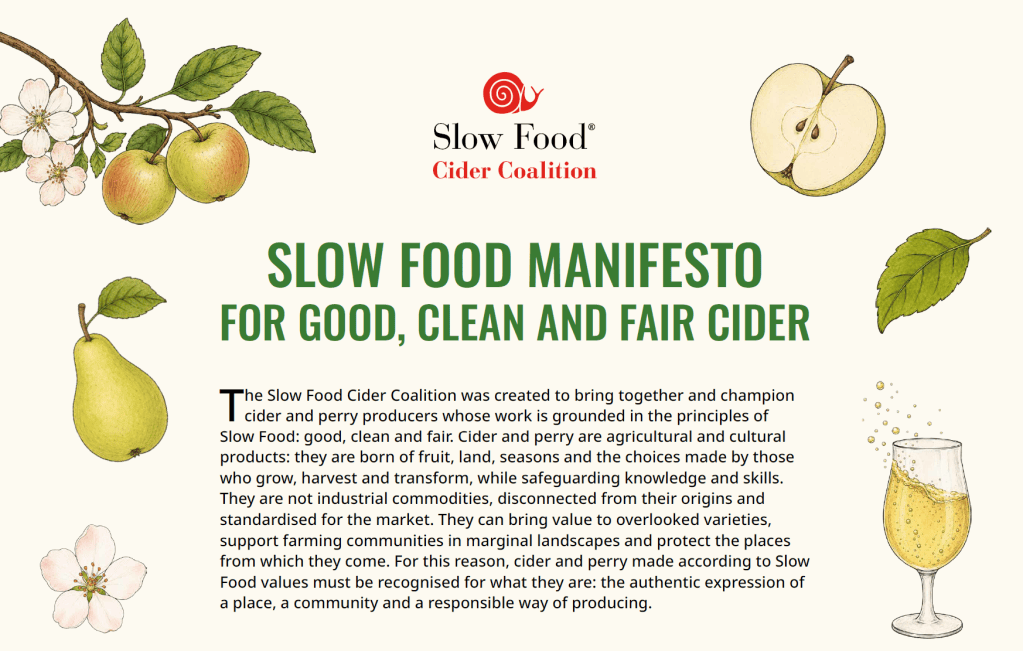
If this doesn’t speak to you as a fan and supporter of artisanal cider, I don’t know what will. It is succinct, encapsulating how at least I feel about the world of cider and perry. And that is the foundation of the Slow Food Cider Coalition.
Place comes first
“Cider and perry must reflect their place of origin, with production methods consistent with the territory in which the fruit is grown. Ideally, the fruit should be grown by the producer. If purchased, it should be locally sourced, or foraged from uncultivated local trees, particularly older varieties that might otherwise lose their place in the market. Fruit should be pressed soon after harvesting, although limited cold storage is permitted.”
How I see it is that regional representations of cider are important, not only from the perspective of terroir, though that is inferred in this section, but also regionality in general; from local varieties and short supply chains that are more environmentally friendly, and conservation through use of fruit that might otherwise be forgotten. All these things contribute to a sense of place.
Fruit grown with respect
“Cidermakers may not use fruit grown with chemically synthesised fertilizers or herbicides. Pesticide use must be limited to those least harmful to the environment and workers. The use of irrigation systems should be limited to preventing critical water stress conditions.”
Straightforward. No herbicides, and only natural fertilisers, if any at all. The only open door is pesticides, but only if absolutely needed to rescue a crop, and only pesticides that are least harmful to wildlife and humans. Preferred is none at all.
Pure juice, no shortcuts
“Cider and perry must be made from 100% undiluted juice. Producers may not use industrially processed bulk juice or juice concentrate, unless produced by the cidery itself for ice cider/perry. The use of sugar is permitted only where this forms part of traditional techniques.”
This is what I welcome most, as a cider or perry made to the slow food cider manifesto standard is guaranteed to be 100% juice. At a time when the EU is still debating a definition of cider that might allow low percentages of juice, a global movement that gives a clear indication of pure juice cider and perry is significant.
Nothing to mask its character
“Oak chips, staves or tannin extracts used to modify aroma or structure are not permitted, as they tend to standardise the taste. The use of indigenous yeasts is encouraged, allowing ciders and perries to fully express their terroir.”
Somewhat strict when it comes to the use of oak chips and the like, especially for those makers wanting to add some structure to their creations, but fair enough. The use of native yeasts is only encouraged, but not a must.
Clear limits on sulfites
“Permitted levels of sulfites should not exceed the limits established under European Union regulations for organic wine.”
Current EU legislation for organic wine allows a “maximum sulphite content of 100 mg per litre for red wine (150 mg/l for conventional) and 150mg/l for white/rosé (200 mg/l for conventional), with a 30mg/l differential where the residual sugar content is more than 2g per litre”. For cider, I am guessing we’d treat it like a white wine, though tannic ciders or perries with high polyphenols as a natural protection might be more comparable to red wines. This may need to be clarified where cider or perry falls, but I would err on the lower level.
Whole botanical ingredients
“Any additional fruits or botanical ingredients must come from whole fruits and plants, grown without chemically synthesised fertilizers or herbicides. The use of concentrates or syrups is not permitted.”
While some people think that other fruit or botanicals do not belong in cider or perry, I will point to the wealth of historical and customary use of herbs and other fruits going back centuries. They belong in there if the maker chooses to do so, and I’m glad that Slow Food recognises this.
Resources used responsibly
“The use of environmental resources, such as water and energy, must be approached consciously and sustainably.”
Cultivating biodiversity
“Biodiversity must be supported through orchard management practices that protect surrounding life, avoiding interventions during flowering periods, and providing habitat through bird nesting boxes and areas with diverse plant species for wildlife, including pollinators.”
Buildings in harmony with the landscape
“Cidery buildings, where construction is necessary, must respect their environmental surroundings. The stewardship of existing structures must be done sustainably.”
Community, cooperation and fair work
“Cideries must play an active role in their surrounding agricultural and cultural communities, promoting cooperation, the sharing of knowledge with other local producers, and a genuine commitment to fair treatment of associates and employees.”
I think the last four speak for themselves and need no further explanation.

Do we need this?
I’d wager that many of you reading this have not heard of Slow Food before, or perhaps only on the periphery, maybe you heard of slow wine, for example. But if you are lucky enough to have an active convivium near you, you may well have experienced the work that local volunteers do to promote good, clean and fair food, usually with an emphasis on local produce. To me, artisanally-made cider is the very epitome of a regional product. In the traditional regions, it has developed a local character over many centuries, and is worth celebrating, though modern life may have judged it a relic, since macro-industrial “cider” with little juice content has corrupted the very idea of what true cider is.
There are so many small, local makers cider the world over breathing new life into cider and perry, bringing a sense of place, season, shining a light on heirloom varieties (that have as much, if not more depth and breadth than wine grapes). Yet many seem undiscovered, or just operating at the micro-local level. I wonder if a movement like Slow Food can help promote such makers at a more regional level, joining them up in a common call, championed by members that are truly passionate about these very traditions and methods. I can’t think of anything slower than making perry, when a tree might not bear enough fruit or many decades, and thin it lives on for centuries.
Compared to the likes of coffee and cocoa growers, cider makers, especially those with their own orchards, find themselves in a privileged position, though it might not always seem so. They are able to deliver a final product that has considerably more monetary value than the raw materials alone. With fewer steps between the cider maker and the end customer, the value chain is short. But that’s not to say that it’s easy (I know all too well that for small makers, selling can be ridiculously hard), or that cider could not benefit from such a global coalition, a group that highlights and respects the very traditions and cultures that cider developed from.
I think it’s worth a try. But we have to work together. I am putting my money where my mouth is, as I was one of those invited to be on the advisory board, and I was proud to represent the coalition at the Terra Madre Salone del Gusto in Turin last month, as the Cider Coalition was launched. I told myself I would not volunteer for more work this year, but I think this is important enough that I I will help out in whatever capacity I can, and I know that the movement will need doers, feet on the ground, covering turf at the local level, to really make a difference.
What’s next?
Carlo Petrini died in May this year. The Terra Madre Salone del Gusto in Turin was the first event since his passing, and even though I never met the man, the gap he had left was palpable throughout the event, as the organisation celebrated his life and continued without him. He set into motion a movement that sought to break down tiers in society; when the King of England and a coffee farmer in Columbia counted him as friend and mourned this loss, that’s crossing the streams a bit.
But the movement goes on, and with the addition of cider, beverages and cacao coalitions, there has been a great leap. But what now?
As a drinker, you can already simply show your support by signing the manifesto. It’s a statement of intent, and the more that Slow Food knows that people support these ideals, the better.
As a maker, if you follow the tenets outlined by the manifesto, it is even more important for you to sign it and show your support.
It is early days yet, and the advisory board is in startup mode. The first serious organisational meeting will be in November, when we can identify the roles and tasks needed to take this forward across many cider regions, and come up with practical steps that will make a difference for maker and consumer alike.
For me, personally, the guarantee for 100% juice-based cider and perry, produced using local fruit, is enough for me to support this concept whole-heartedly. And I sincerely hope that knowing that a cider is based on the Slow Cider principles becomes a mark of trust that supports local, artisanal makers the world over. So join me, raise a glass, and put your name where it counts.
Discover more from Cider Review
Subscribe to get the latest posts sent to your email.

