By a region’s apples shall ye know it.
This isn’t quite true. Whilst apple varieties, certainly those which are commonly made into cider, don’t yet have the same degree of crossed-border international ubiquity as many wine grapes, the same doesn’t hold for county lines within the UK. Take Dabinett for instance. Responsible for some of Herefordshire’s greatest ciders, and the country’s most widely-planted cider apple. Imagine how much would have been lost had it remained only available in Somerset.
I find it wonderful and fascinating that, at present, you can find cider apples from the West Country growing 500 miles north on the Black Isle. That cidermakers in Herefordshire are taking an interest in the likes of Sussex’s Egremont Russet and Suffolk’s Discovery. I think one of the great joys of the next five to ten years or so, as the interest in apple varieties broadens, will be in gradually unpicking the differences in flavour and texture that are wrought by these subtly differing climates.
That being said, it is interesting – to me, anyway – to consider a county’s native varieties and ponder what they possibly suggest about that county’s historical cider character. So, this being Devon week on Cider Review, I thought I’d dig up a couple of ciders showcasing Devon apples for your delectation.
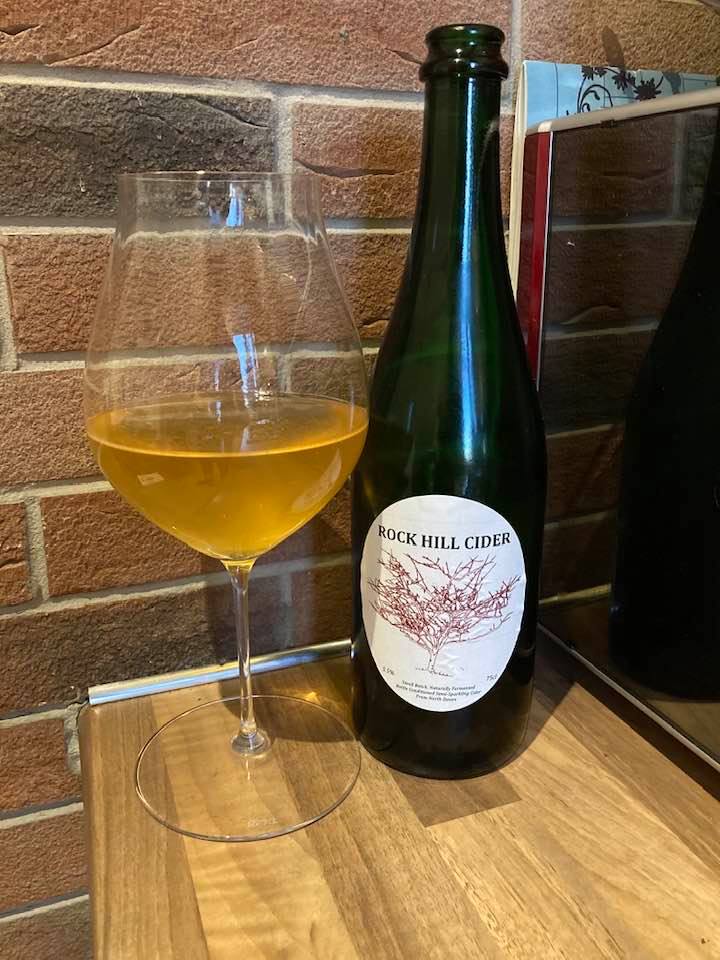
First up is Beara 2018, from Rock Hill, a Devon cidery of which I had not previously heard and which google seems to be scratching its head over as well. Most of my searches led, bizarrely, to the City of London, and combing social media drew a blank too. So, if anyone has any information on these folk, answers, if you please, on a postcard. (Or in the comments section below.)
Beara is a blend of Tremlett’s Bitter, Sweet Alford and Golden Knob, with Tremlett’s being the dominant component. Tremlett’s Bitter is, in malic terms, the beast of Devon. Notoriously intense of tannin and phenolic, it sits in a similar category to Chisel Jersey as an apple often used only for “seasoning”.
According to Scrattings, Beara has enjoyed a secondary in-bottle fermentation for a natural sparkle. A bottle, at the time of writing, is yours for £9.50.
Rock Hill Cider Beara 2018 – review
Colour: Burnished gold
On the nose: I can’t speak to a huge experience of the other two apples in this blend, but the phenolics – the almost smoky meatiness and earthiness – of the Tremlett’s is coming through very well with beeswax and honeysuckle and yellow fruit. Almost a touch of chorizo. Pretty full-on aromatics.
In the mouth: Mousse, but not to a distracting extent. Full bodied, with tannins that grip but aren’t excessive. Lots of freshness and pith to the fruit – orange and soda, waxy dried apricot, lemon zest. The character of the Tremlett’s really pops – the light cured meat, rainfall on earth and touch of cheese rind. Loads of minerality. Virtually dry. This has a lot of almost Ross on Wye-esque touches, you know. And in my book that will seldom be a bad thing.
In a nutshell: Like this. Loads of varietal character, really well-made.
Sticking to our Devon varieties, but demonstrating the earlier point of inter-county migration, our second stop takes us to Leicestershire’s Charnwood. We’ve met Charnwood before in the form of their 2018 Dabinett, which James wrote up here, and I later added my own notes on here. I would also urge you to read the wonderful cidery profile written by Laura Hadland on Pellicle. The cidery, and its cidermaker, Rob Clough, recently celebrated ten years of production – positively venerable by modern cidery standards! Many of the trees in his orchard have been grafted with scion wood from Ross on Wye, so today’s single variety Browns is well-travelled indeed.
Browns sits at the opposite end of the spectrum to Tremlett’s – classed as a sharp apple; all acid, no tannin. It’s worth noting that Charnwood’s full-juice 2019 clocks in at a hefty 7.3%, which is on the chunky side for Browns despite 2019 being generally a lower sugars year across much of the UK. Sunlight hours? Rainfall? Heat? Tree husbandry? Apple selection? Impossible to draw conclusions from just one sample, but a nice demonstration of the potential curiosities of regionality and the impact of producer.
Hard to find Charnwood online at the moment *coughs loudly in the hope that Scrattings, Fram Ferment and Cat in the Glass will take note* but if you’re lucky enough to live in Leicestershire, a 500ml bottle of this weighs in well under a fiver.
Charnwood Browns 2019 – review
Colour: Gold
On the nose: A bright swathe of high tones – green apple skin, lemon juice, pine and a little wood polish. Very crisp and precise fare. A tiny bit of estery, citrusy disinfectant.
In the mouth: Really zingy, fresh acidity – bright and brisk without being searing or aggressive. Intense flavours of green apple and lemon with that fragrant brush of pine – both needles and wood. Very refreshing. Sits entirely in the high octaves. Very clean – there’s a touch almost of chlorine in the midst of it all, but not in an off-putting way. A cider to drink all through summer.
In a nutshell: A fresh, precise, sensitive expression of its variety. Great value too.
Conclusions
Yep. Lots of time for both of these. The Tremlett’s and the Browns shine through in each one respectively, both totally clean, full-juice, expressive. Neither is wildly complex, perhaps, but both are very tasty. A world apart from each other in flavour, but you can buy either with confidence. Charnwood continues to go up and up in my estimation, and Rock Hill is a name I shall continue to look out for on this evidence.
Anything we can glean from the varieties? Well, whilst they may sit in wholly different malic camps, what stood out to me on tasting them is that they both share a real sense of textural definition. These aren’t pillowy, voluptuous creatures like Dabinett or Yarlington; they’re harder-lined, more structured and direct. Historical records ascribe to Devon cider a particular firmness, be it of tannin or acidity. That’s something that would tally with my experiences of these apples and would explain the historical tendencies towards multiple rackings for sweetness and softness of which I’ve read. That said, I’m making huge theoretical leaps and assumptions here – almost certainly confirmation bias – which I’d advise you to take with a pinch of salt. That notwithstanding my interest in Devon varieties is thoroughly piqued, and I look forward to investigating further in the near future.


Leave a Reply