I turn on the headlights as I hurtle through the gloom of a September morning. Rain hammering down from dense, oppressive clouds that drape over rolling hillsides. Blessed rain! Winding the window down I curse my premature waterproofs. My little car weaves down lanes that emit a terracotta glow, a journey showered in layers of history. Devon is huge, the lanes winding and labyrinthine, with glimpses of orchards beyond looming hedgerows offering a mere flicker of the county’s agricultural heritage. This land where apples were grown in their millions for centuries.
Down a driveway so steep that winter must present some difficulties, a central stripe of vivid green. I wonder at the number of journeys that must have passed into this ancient farmyard. The sun breaks through as I stepped from cloying humidity into a fresh September morning. An almond (peach or nectarine?) thrives beside a stable wall. Fruit is at home here. Beyond the concrete, an old orchard leans into the slope, guarded by geese. Orbs of deep red, bright pink, beaming yellow. Oh, what treasures are hidden there?
My mind racing with so many questions on the apples of the county we’ve come to call home. The county where we planted our orchard and are learning, slowly, about the great cultural influence of its cider. We stumble over gaps in our knowledge that our time as orchard stewards and cider makers has yet to fill.
This meeting has been weeks in the planning. Dates aligning far into the future. What we are to discuss – years in the planning. Decades!
‘There is no fruit, in temperate climates, so universally esteemed, and so extensively cultivated, nor is there any which is so closely identified with the social habits of the human species as the apple’. Robert Hogg, 18511.
Of all the pomonas, this county’s has eluded us.
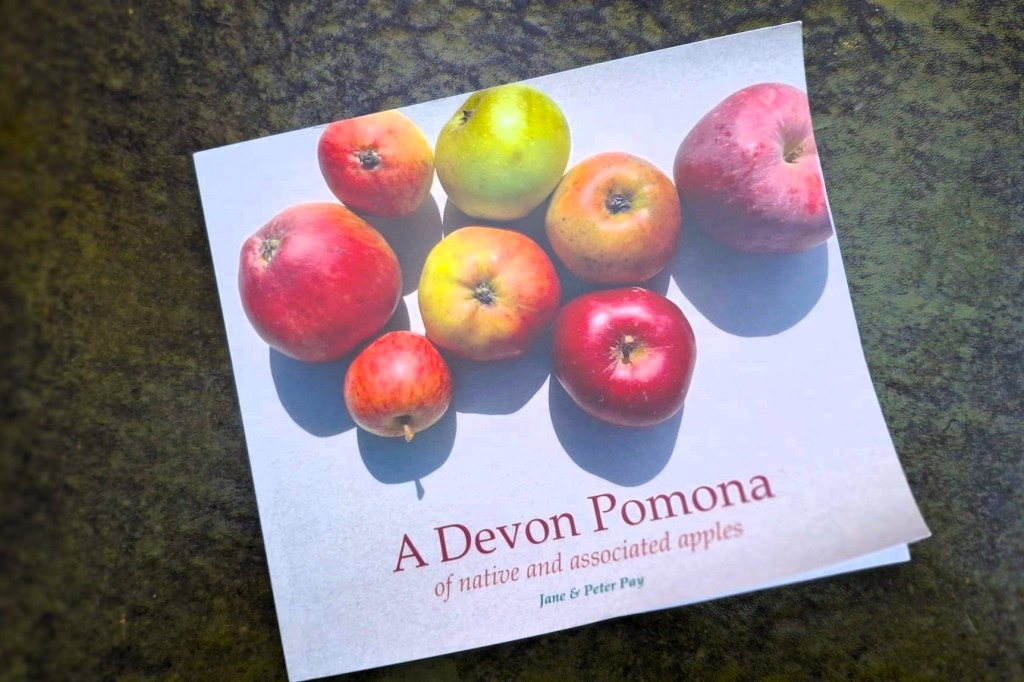
A Devon Pomona
From the history of the apple and Devon’s orchards, through monographs of apples that have long been cultivated in Devon, to categories of cider apple and synonyms. There are ninety records held within, from ADW Atkins to the Woolbrook Russet – a lot to absorb before harvest fully takes hold and our knowledge comes under scrutiny
The enchantment of the apple is never fully realised. There’s always more. One more orchard. One more tree. Endless possibilities. So it is that this book is nearly forty years in the making. The life’s work of a couple who bit into temptation years ago and have been nibbling away ever since.
The publication of this Pomona seems timely as we navigate the complexities of this harvest and ponder the future longevity of trusted varieties. What trees were planted, which shone in cider production and were retained, which will survive?
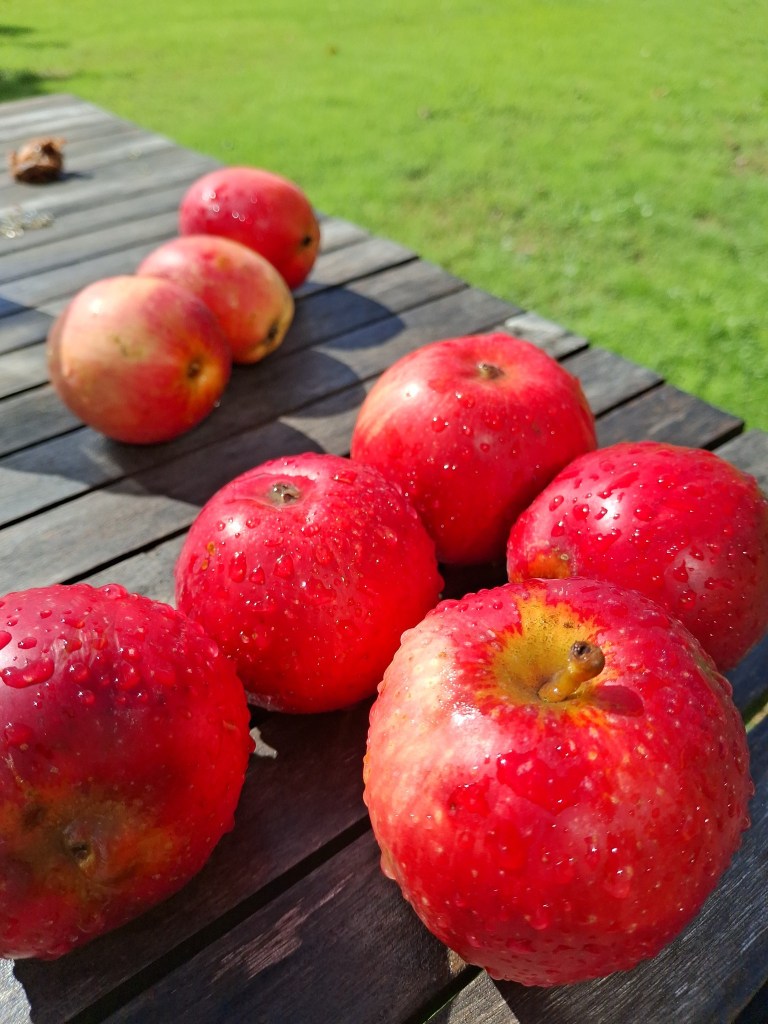
A warm welcome on a sun-soaked veranda, droplets of rain held on apples gathered beside the door. Dartmoor sits beyond the valley. So long has this farmhouse stood here that the surroundings have grown up around it, nestled amongst emerald green. Here it has stood for seven hundred years. Give or take. Its current owners for the past forty some. Their farm used to grow some apples for Showerings, such was the reach of the Somerset producer. Apples from their Devon orchards delivered and exchanged for apple trees over the years. Some of those trees stand beside the farm today.
My enthusiasm was sprinkled with a dusting of embarrassment at how little I truly know, but how am I to hold even a fraction of the knowledge that has been amassed over so many years. Clutching my notebook, I gathered my thoughts – I still have so much to learn about orchards, apples, cider. As the authors confirm – how can we truly say that each and every one has been documented. Which is, in part, why the Devon Pomona has been so long to the press. For when do you stop searching?
Jane and Peter Pay are long standing Devon (and further) orchard advocates. Neither has a horticultural background. The couple began their orchard lives after moving to Devon in the 1980s. On the farm where they settled stood an ancient orchard of thirty or so trees. The farmer they bought from shed some light on the varieties his father had planted decades before, but there remained trees of unknown identity. This paucity of information and awareness of the continuing loss of orchard habitats (and the knowledge that lay within them) stirred the couple to act. Their commitment to the cause runs deep, as the publication of this Pomona reveals. They were founding members of Orchards Live, gathering momentum to identify and preserve local orchards. In 1991 they spearheaded the North Devon ‘Save our Orchards’ campaign and have been working to preserve Devon’s orchards ever since.
The foreword to the book has been penned by Liz Copas, author of several books herself and one of the Long Ashton research team. Liz has been ‘persistently encouraging’ the couple to publication for years. Long-time acquaintances, they have been brought closer by their shared work on DNA testing of apples, and preservation of orchards and heritage varieties has brought them closer still. As with any work of great cultural and historical breadth, the end result has not been easily achieved.
Jane notes that Devon has long been a poor promoter of its cider heritage. Peter focussed on the historical section of the book, researching from historical texts and from tithe maps. Dean Miles of Exeter aided the sparse recording of Devon orchards through his 18th century survey of Devon cider and its qualities. Large estates such as Cotehele and Broadclyst exchanged varieties, and the records kept by wealthy landowners offer some clues to lauded apple varieties. Farmers and gardeners kept few records of the trees they planted or the blends that elevated their cider making prowess, with word of mouth informing many cultivation choices.
As we chatted of harvest and how their quest for discovery evolved, Peter regaled a tale of an apple they sought in an autumn past, during a gloomy downpour in the far reaches of Devon, on an old estate. After fuel and entry fees, the cost of finding this unique apple became bitter as he was clocked over the speed limit on his way home. That one monograph alone demanded £147 for the pleasure. Many of us hold similar tales of when our passion has driven us further than our wallets can tolerate. We spoke of so many varieties that day and my notes fail me on that specific culprit, but his tale rang true of visits many of us will have taken to orchards rumoured to be bathed in gold. Orchards that lie hidden from view but hold the promise of rare cider apples galore, only to visit and find a row of ancient Bramleys.
Through combining their research with the registration of local cultivar scheme, from 2016, the documentation of Devon apples has grown and gained some clarity. They both acknowledge it’s almost impossible to guarantee to have recorded every variety. The tinkering and nudging by devoted minds is apparent in the printing of an errata to accompany the copies already printed, with three suggested edits (for the next edition?!). For as the Register of Local Cultivars and DNA testing becomes widespread, the kindred of varieties known by differing regional names will become ever more apparent.
Identification should get easier as DNA technology becomes more accessible, but the lack of a standard method of analysis between DNA projects is a source of frustration for everyone I spoke to who has worked on sequencing apple genetics. The couple are keen for there to be wider testing, firm that The Girls offered us an opportunity that we should continue to explore. That revisiting laboratory research may lead to further, fruitful discoveries, though the who and the how of its continuation lies unanswered.
Where varieties have been found that have been cultivated, but few survived, Jane has worked with the Royal Horticultural Society Rosemoor and Thornhayes nurseries to propagate future generations. The orchard at RHS Rosemoor now holds many of the varieties from A Devon Pomona.
Within the work for Orchards Live and A Devon Pomona, Jane has found a needling interest in red fleshed apples. Regional appreciation of apples has muddied the waters in the vast pomological pool of nomenclature that we gaze into. Throw in the mutations that sports can conceal and the waters are muddier still. Her focus has revealed that apples at Wisley, the Bradninch Black and Pendragon, all share a morphology. An entwined complexity that requires further investigation and clarity. Something she will continue to look to.
In recognition of commonality between varieties and regions, the monographs held within the Pomona provide some clarity on varietal synonyms. Take the Pay’s Prolific (a consistently good cropper named in honour of Jane and Peter, who used to donate some of the cider crops from their orchard). DNA analysis was carried out in 2016 before it was catalogued as a Devon cultivar in 2019. It was later cross checked against a distant memory of Liz Copas from her Long Ashton days. Further testing in 2023 revealed the Pay’s Prolific to be one and the same as the Fair Maid of Devon.
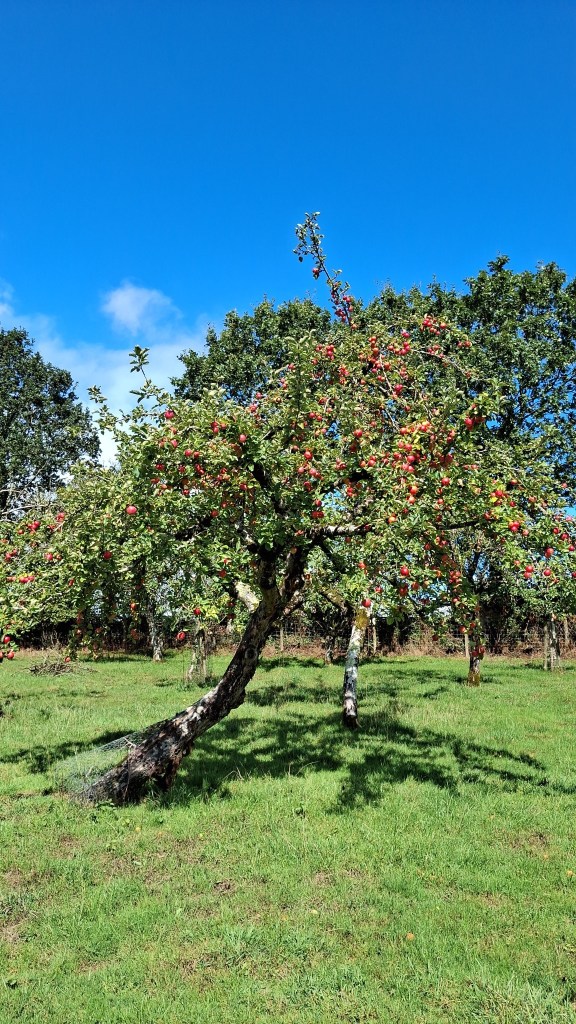
Or is that the Crimson King? It depends upon who you ask. The naming of a variety so often being of a place or a person there’s no surprise that many have multiple monikers.
Those of us who pass hours in wrangling the ‘identification’ of unknown apples we gather (before resigning ourselves to a ‘maybe’) will all know of the complexities of the apple. Many of us have stood, frown firmly fixed, rolling a fruit within our palm; stalk, cavity, colour, shading, basin, sepals – settling firmly on an ID, only to be fooled time and again.
We’d be lucky to find a Lucombe’s Seedling, an early dessert apple. From the Pomona – ‘susceptible to scab, woolly for eating after just short days and storing poorly’. Those few short days are the key – crisp, juicy, spicy with tropical notes. Originating around the Exeter area in the early 1800s, it travelled the county and beyond, perhaps due to it keeping its shape during cooking, its pleasant juice or the seasonality resulting in a cider that could be drunk by Christmas. An all-rounder that also held names of Kirton Fair, Listener and Newquay Prizetaker. In a time when orchards must have served to provide multi-purpose fruit, it sounds like a winner! With reported origins so close to our own orchard, surely there are trees from which we harvest that bear this name but so few ancient orchards have (accurate) maps to guide. As with some varieties that have passed into relative obscurity as production of scale emerged and dominated, an apple described as ‘weak…susceptible to scab…some canker…some years better than others…’ may just not have met the grade.
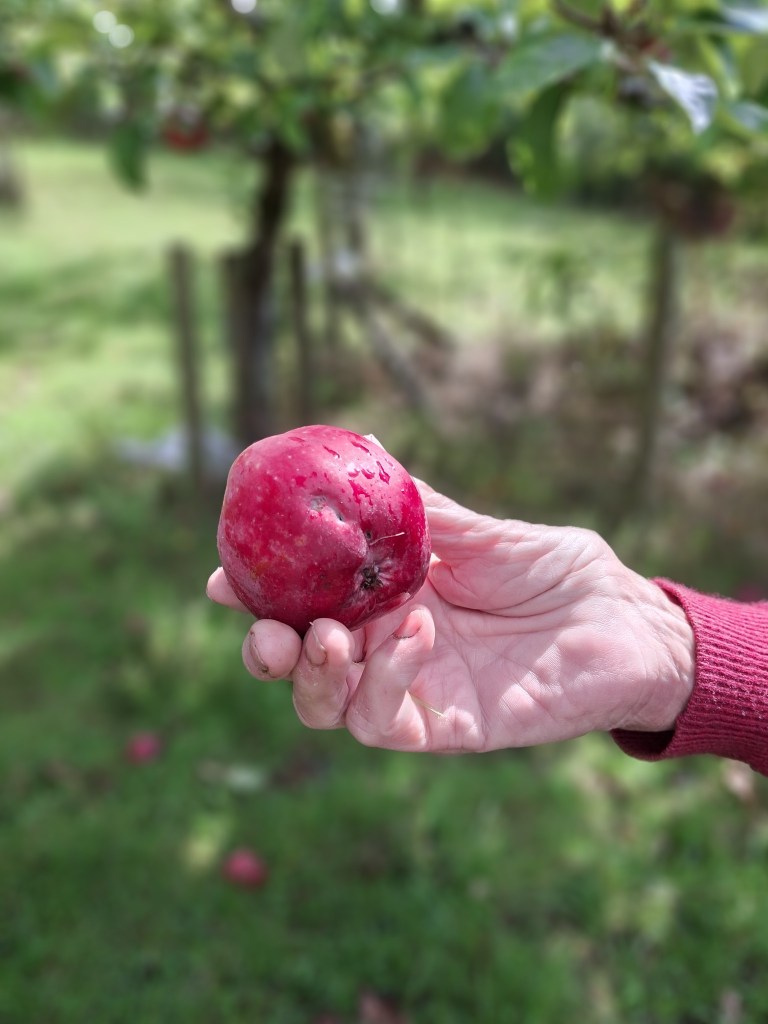
Grandpa Ailes, a Greasy butcher, a White Close Pippin, or the thirst invoking Quench – these are the trees that many a modern cider maker would love to encounter with good enough yield to ferment a single variety.
Jane and Peter’s knowledge of the trees is underpinned with a long history of making cider themselves. Over the years the two have dabbled with fermentation experiments with wild yeast against pitched yeasts, different apples and different sugar levels. One of their most notable fermentations being a trial of the yeasts without the apple. Where water alone offered the carrier for the fermentation, the wild yeast fermentation offered the better flavour profile in its outcome. An outcome many of us will be nodding our heads to. The couple still make a little cider, enjoying the delights of the ferment and camaraderie of sharing their ferments.
When questioned on their favoured Devon variety, they both reply ‘What would you want to use it for?’. Coleman’s Seedling was a nominated apple for cider production, ‘one of the best in the mild sharp group’ tested at Long Ashton and registered as a Devon cultivar in 2019.
We spoke briefly on the challenges that trees must pass in the face of climate change. The fickle spirit of mother nature and her influential meteorological output a topic much in the limelight. The couple add some debate over the evolution of varieties and whether those that we know today have, or can, survive as the earth experiences ongoing fluctuation and change to its climate. Their combined knowledge of seasons, and seasonality, offering a balancing view on how differing varieties may fare in the promised future of petulant weather. Years of observation reassure them that trees which have survived in their historical regions will continue to do so once established.
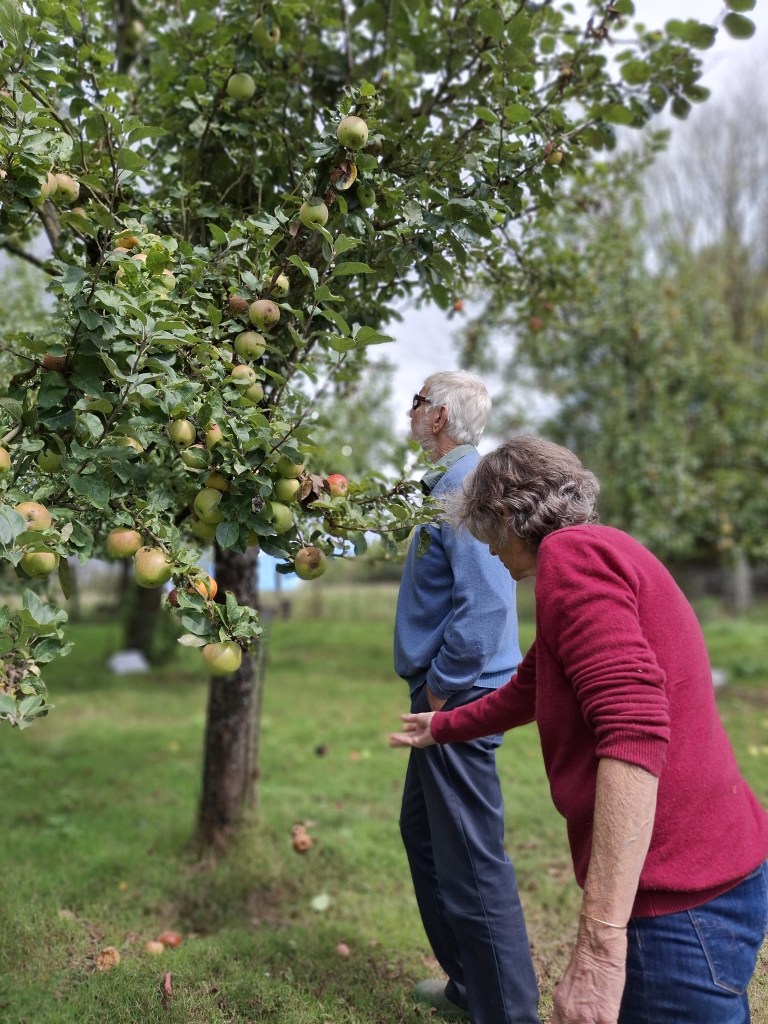
With talk drifting to the practical elements of orchards, trees and harvest, we headed to the orchard. A trio striding under the strengthening sun to trees that now hold a written legacy.
Dozens of trees have been planted in addition to those inherited. Their names now forever in ink to bolster the tale of Devon’s cider making history. Brendon (Butter), Farmer Snowe, Lemon’s Scarlet, Don’s Delight. Jane has top worked and grafted to ensure the survival of many a variety when threatened. Trees that bear their name proudly (and with an encouraging permanence) from ceramic labels. A single tree held a multitude of labels, its trunk now feeding more than five boughs bearing different fruit. If Jane were to plant an orchard today with a view to cider making it would contain, amongst others, Browns, Ellis Bitter and Bickington Grey – and do more top working to garner the perfect blend.
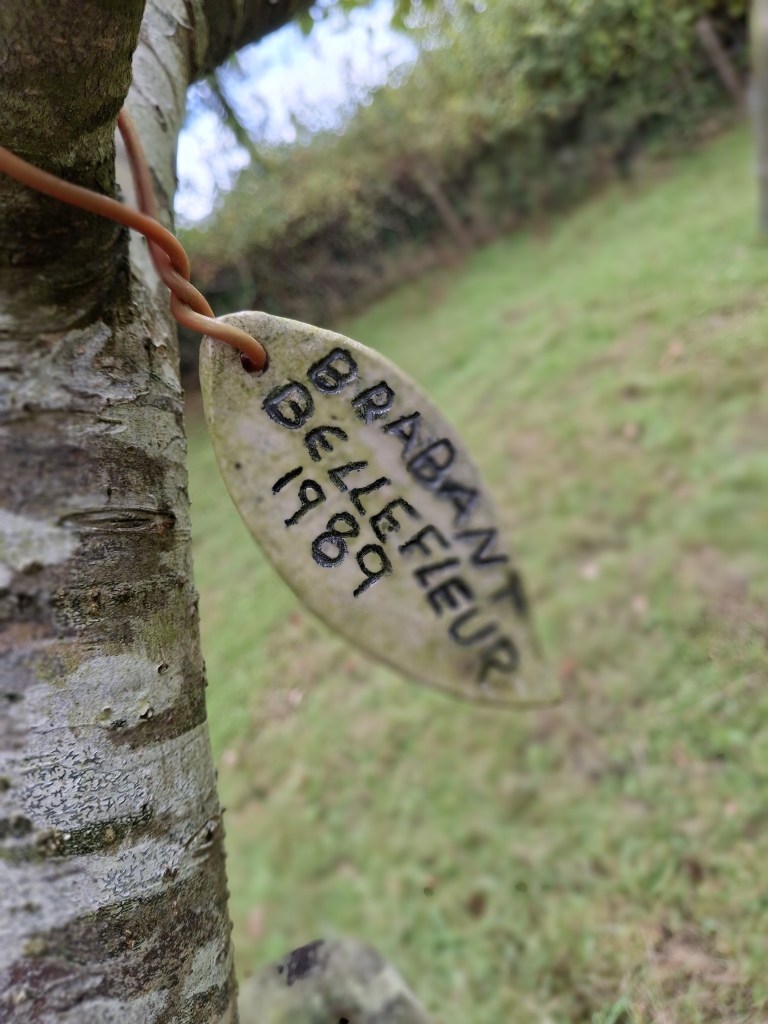
There’s an effortless comfort in the calm reassurance of someone so entwined with a lifestyle, an environment, a practice that they have grown to become experts in their field. Jane and Peter hold this. Their knowledge lies sinew deep. A wisdom much admired and yearned for.
As we stand under the early autumn sun, Peter offers a wry smile and asks if I’ve ever journeyed eastwards from Barnstaple in the spring? For, if I had, I would see dozens of apple trees deep in blossom, a floral farewell for the procession of holiday makers. Gribble2 upon gribble representing traffic jams of yore and the distance crept before the apple core is all that’s left to be tossed from the windows of wretched travellers.
Jane and Peter acknowledge their magnum opus can never be truly complete. There will, forever, be potential for new apple varieties to become known, but the ones our Devonian ancestors valued for cider are now bound together for all to see3.
1 British pomology; or, The history, description, classification, and synonymes, of the fruits and fruit trees of Great Britain ..
2 In English orchard folklore, a gribble refers to a wild apple tree that grows spontaneously from discarded apple seeds
3 (Copies are available to buy through Orchards Live).

Leave a Reply